2025 Nobel Prize in Medicine paves way for possible new cancer treatments
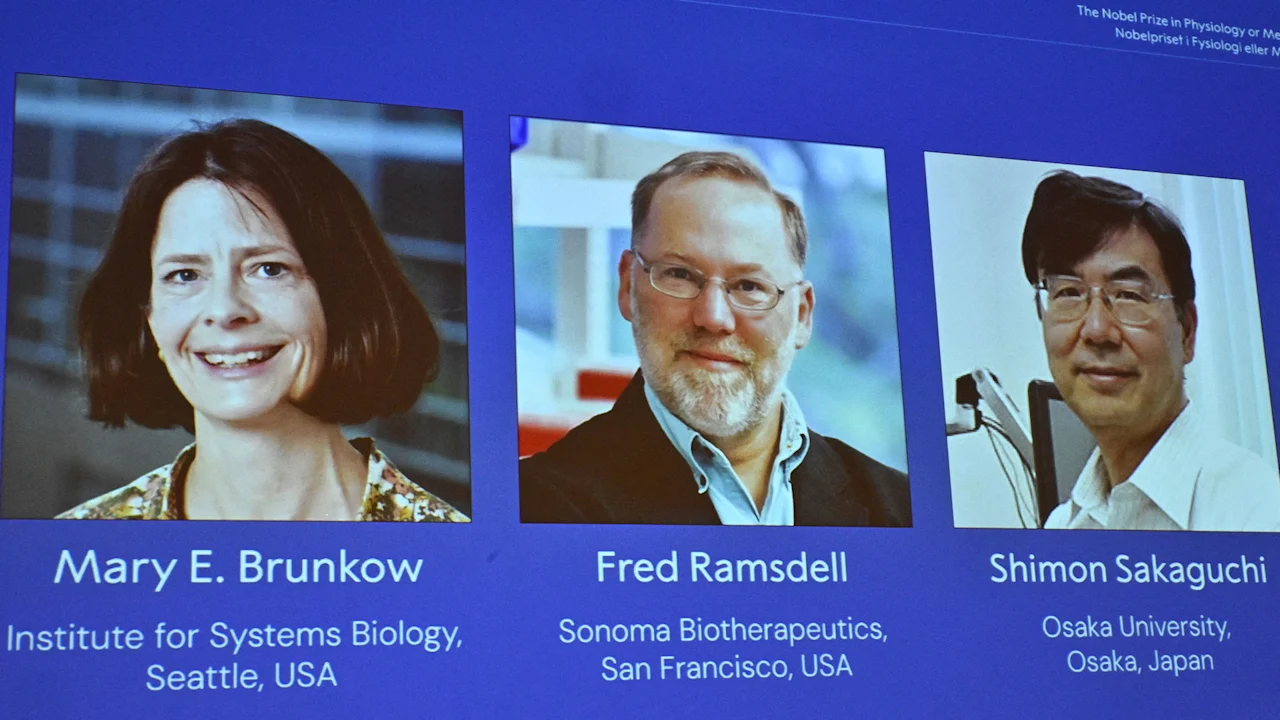
American scientists Mary Brunkow and Fred Ramsdell and Shimon Sakaguchi from Japan won the 2025 Nobel Prize in Physiology or Medicine on Monday for work shedding light on how the immune system spares healthy cells, creating openings for possible new autoimmune disease and cancer treatments.
This year’s prize relates to peripheral immune tolerance, or “how we keep our immune system under control so we can fight all imaginable microbes and still avoid autoimmune disease”, said Marie Wahren-Herlenius, a rheumatology professor at the Karolinska Institute.
Sakaguchi told reporters outside his university laboratory that “I feel it is a tremendous honour,” Kyodo news agency reported.
REGULATORY T CELLS: THE IMMUNE SYSTEM’S ‘SECURITY GUARDS’
The winners for medicine are selected by the Nobel Assembly of Sweden’s Karolinska Institute medical university and receive a prize sum of 11 million Swedish crowns ($1.2 million), as well as a gold medal presented by Sweden’s king.
Brunkow is senior programme manager at the Institute for Systems Biology in Seattle, while Ramsdell is scientific adviser at Sonoma Biotherapeutics in San Francisco. Sakaguchi is a professor at Osaka University in Japan.
“Their discoveries have laid the foundation for a new field of research and spurred the development of new treatments, for example for cancer and autoimmune diseases,” the prize-awarding body said in a statement.
The laureates identified so-called regulatory T cells, which act as the immune system’s security guards that keep immune cells from attacking our own body, it added.
After announcing the winners, the institute’s Thomas Perlmann said specific therapies had yet to win market clearance but more than 200 trials on humans involving regulatory T cells were ongoing.
Among companies in the early race, Sonoma Biotherapeutics , which Ramsdell co-founded, is partly funded and supported by U.S. drugmaker Regeneron to work on therapies against diseases including inflammatory bowel disease.
Also targeting that condition, Quell Therapeutics has partnered with AstraZeneca.
Other biotech firms exploring the approach include Bayer’s BlueRock.
MEDICINE THE FIRST PRIZE OF NOBEL SEASON
The Nobel Prizes were established through the will of Alfred Nobel, the Swedish inventor of dynamite and a wealthy businessman. They have been awarded since 1901 for outstanding contributions in science, literature, and peace, with interruptions mainly during the World Wars.
The economics prize was added later and is funded by Sweden’s central bank, the Riksbank.
Winners are selected by expert committees from various institutions. All prizes are awarded in Stockholm, except for the Peace Prize, which is presented in Oslo — a possible legacy of the political union between Sweden and Norway during Nobel’s lifetime.
Past recipients of the Nobel Prize in Physiology or Medicine include renowned scientists such as Alexander Fleming, who shared the 1945 award for discovering penicillin. In recent years, the prize has recognized major breakthroughs, including those that enabled the development of COVID-19 vaccines.
Last year’s medicine prize was awarded to U.S. scientists Victor Ambros and Gary Ruvkun for their discovery of microRNA and its key role in how multicellular organisms grow and live, helping explain how cells specialise into different types.
Medicine in accordance with tradition kicks off the annual Nobels, arguably the most prestigious prizes in science, literature, peace and economics, with the remainder set to be announced over the coming days.
More than a century after their inception, the Nobel Prizes remain steeped in tradition. The awards culminate in ceremonies attended by the royal families of Sweden and Norway, followed by lavish banquets held on December 10 — the anniversary of Alfred Nobel’s death.
($1 = 9.3898 Swedish crowns)
(Reporting by Niklas Pollard, Johan Ahlander in Stockholm; Additional reporting by Terje Solsvik in Oslo, Kiyoshi Takenaka in Tokyo and Marie Mannes and Greta Fondahn in Stockholm; Writing by Ludwig Burger in Frankfurt; editing by Alex Richardson)
—Johan Ahlander, Niklas Pollard and Ludwig Burger, Reuters
Originally published by fastcompany.com. Syndicated material does not necessarily reflect the views of Grazia British.
More Culture

Don’t Pull Out of Germany
Merz’s stupidity is no excuse for a stupid response. Source link
Step inside the gorgeous, futuristic offices of Vast, the startup designing the next-gen space station
A tall baobab tree greets people inside the Long Beach, California, headquarters of Vast, an aerospace company that is building the space station of the future. It’s planted beneath a…
5 ways high-performing teams stay calm when everything’s on fire
When markets swing, plans break, inboxes explode, and everyone starts saying the situation is “unprecedented” again, most teams do what humans have always done under pressure: they grip…

Confused Trump Openly Admits Plot to Rig Midterms as Polls Turn Brutal
Last week, the Supreme Court gutted protections against racial gerrymandering, and Donald Trump is already urging Republicans to seize on it. Trump unleashed a Truth Social rant on Monday…