
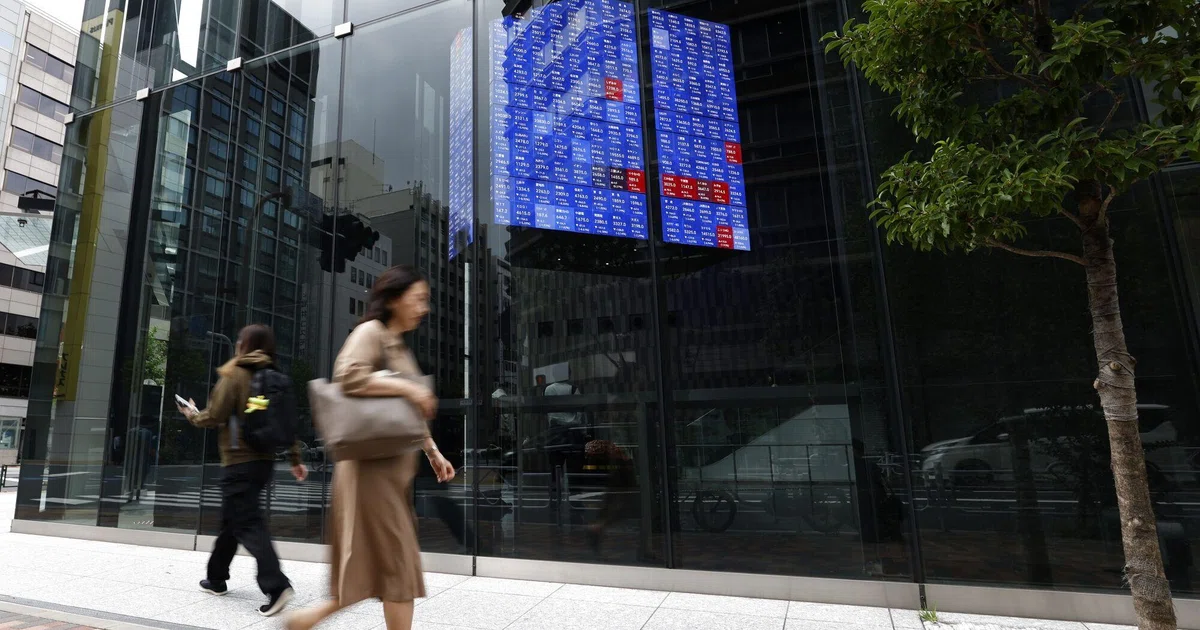
Asia: Shares rise as Japan politics weigh on yen
Asian markets rose on Monday (Sep 8), with Tokyo up nearly two per cent after Japanese Prime Minister Shigeru Ishiba’s decision to resign pushed down the value of the yen.
Investors were also digesting weak US jobs data, while crude prices climbed after eight key members of the Opec+ alliance said that they had agreed to again boost oil production.
“A combination of weak US labour market data coupled with rising political uncertainty in Japan dominated global markets as we started the week in Asia,” Michael Wan at MUFG said in a note.
Tokyo’s Nikkei index gained 1.9 per cent, with Japanese exporters benefiting from a slide in the yen’s value, one US dollar bought 148.14 yen in morning trade, up from 147.07 yen on Friday.
Japanese bond yields also climbed after Ishiba said on Sunday that he would step down after less than a year in power, heralding fresh uncertainty for the world’s fourth-largest economy.
“I don’t think we can say that the resignation of PM Ishiba is a complete surprise, as it’s been mooted for some time, but the timing of the announcement is certainly unexpected,” said Michael Brown, senior research strategist at Pepperstone.
BT in your inbox

Start and end each day with the latest news stories and analyses delivered straight to your inbox.
“As for the market reaction, this obviously introduces significant downside risks for the (Japanese yen) and for long-end” Japanese government bonds (JGBs), he added.
Last week, the yield on 30-year JGBs hit a record high, following rises in the United States and Europe on the back of concerns about political uncertainty and public finances.
Potential candidates to be the leader of Japan’s ruling party are “all likely to propose looser fiscal stances than Ishiba, hence further pressuring the long end of the curve, where demand for JGBs had already been waning quite significantly”, Brown said.
Hong Kong and Shanghai were 0.3 per cent higher in morning trade, with Taipei up 0.5 per cent and Seoul also gaining 0.3 per cent.
Singapore rose 0.1 per cent and Wellington was up 0.1 per cent, but Sydney fell 0.3 per cent.
Last week’s US jobs data has cemented expectations of a US Federal Reserve interest rate cut later this month.
In Asia, “rising expectations of Fed rate cuts and with that lower US yields should be a welcome development to some extent, providing some breathing space and policy room for Asian central banks”, said Wan of MUFG.
“Nonetheless, the key risk for Asian currencies would also lie in a sharp US slowdown and hard-landing recession through sharply slower exports to the US, which we stress is not our base case.” AFP
Originally published by businesstimes.com.sg. Syndicated material does not necessarily reflect the views of Grazia British.
More Culture

Don’t Pull Out of Germany
Merz’s stupidity is no excuse for a stupid response. Source link

Step inside the gorgeous, futuristic offices of Vast, the startup designing the next-gen space station
A tall baobab tree greets people inside the Long Beach, California, headquarters of Vast, an aerospace company that is building the space station of the future. It’s planted beneath a…

5 ways high-performing teams stay calm when everything’s on fire
When markets swing, plans break, inboxes explode, and everyone starts saying the situation is “unprecedented” again, most teams do what humans have always done under pressure: they grip…

Confused Trump Openly Admits Plot to Rig Midterms as Polls Turn Brutal
Last week, the Supreme Court gutted protections against racial gerrymandering, and Donald Trump is already urging Republicans to seize on it. Trump unleashed a Truth Social rant on Monday…