
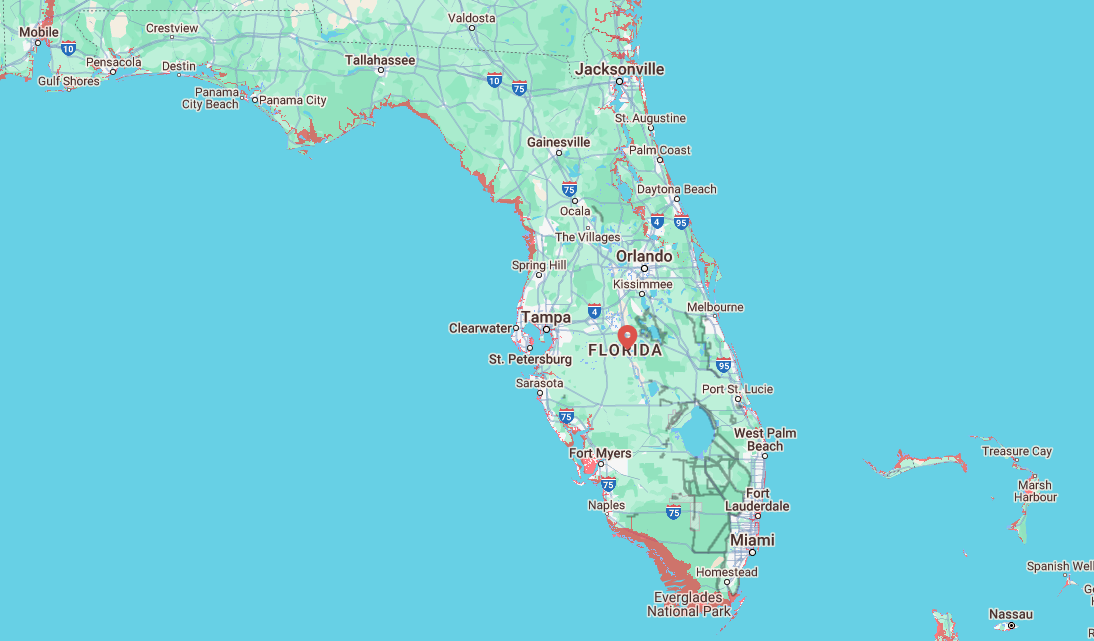
Florida map reveals cities that could be underwater in 2050
A new map shows which parts of Florida are vulnerable to sea-level rises and increased flooding due to climate change.
The map, developed by researchers at Climate Central, uses advanced predictive modeling to show the areas that could be at risk by 2050. Florida is one of the states most vulnerable to rising sea levels due to its extensive coastline and low-lying topography.
The map shows that coastal areas in the south of Florida are most at risk, particularly the state parks and reserves and the low-lying Florida Keys. Parts of Florida's southwestern coast could be totally submerged, including the Everglades National Park, which spans over 1.5 million acres and is home to hundreds of species of birds, mammals and reptiles.
The outer coastal areas of Cape Coral, including its extensive network of canals, would also be vulnerable to water inundation.
The Sunshine State's eastern coast would also be affected by the rising water.
Parts of Fort Lauderdale, particularly the waterfront neighborhood of the Las Olas Isles, would be partially submerged. Similarly, parts of Jacksonville that sit on rivers and waterways will also experience water inundation.
The cities of Miami and Tampa would be less badly affected, but they would still have some water encroachment on their green coastal regions, according to the map's projections.
The sea level along the U.S. coastline is projected to rise, on average, by around 10 to 12 inches by 2050, according to projections from the National Oceanic and Atmospheric Administration. This increase is equivalent to the total rise observed over the century from 1920 to 2020.
"People living on low-lying coastal land, like river mouths, are already facing higher flood risks because of the 20-40 cms [7.9—15.7 inches] of sea level rise measured along U.S. coasts over the past few decades. Their communities can expect the worst of the impacts as water levels continue to climb," Peter Girard, a spokesperson for nonprofit organization Climate Central, previously told Newsweek.
Ben Strauss, the president and CEO of Climate Central, previously wrote that by 2050 large parts of the United States are likely to see storm surges on top of sea level rise reaching at least five feet.
South Florida is particularly at risk as around 2.4 million people and 1.3 million homes, which account for nearly half of the national risk, are located within four feet of the high tide line, Strauss said.
"Overall, sea level rise is making the odds of a South Florida flood reaching more than 4 feet above high tide, by 2050, on par with the odds of losing at Russian roulette," he wrote.
Originally published by newsweek.com. Syndicated material does not necessarily reflect the views of Grazia British.
More Lifestyle

Millennium Docs Against Gravity Festival Director on How Documentary Film Helps Audiences Find ‘Sense Amid the Chaos’ of Current Events
Poland’s Millennium Docs Against Gravity, the documentary film festival that takes place simultaneously across seven Polish cities, returns for its 23rd edition from May 7 – 17 with a…

Mubi Acquires Na Hong-Jin’s Korean Thriller ‘Hope,’ Starring Michael Fassbender, Alicia Vikander and Hoyeon, For Multiple Territories Ahead of Cannes Premiere
Mubi is once again flexing it financial muscle ahead of Cannes, picking up one of the buzziest films heading to this year’s festival. The arthouse distributor and production company has…

MetFilm Sales Acquires Mongolian Documentary ‘Colors of White Rock’ Ahead of World Premiere at Tribeca (EXCLUSIVE)
London-based MetFilm Sales has acquired Mongolian filmmaker Khoroldorj Choijoovanchig’s debut feature documentary “Colors of White Rock” for worldwide sales representation. The film will…

Brit Detective Drama ‘Bergerac’ Bought for U.S. by PBS Distribution (EXCLUSIVE)
British detective drama “Bergerac” is heading to the U.S. with PBS Distribution following a deal with Banijay Rights. The acquisition comes ahead of next week’s London TV Screenings, with…