
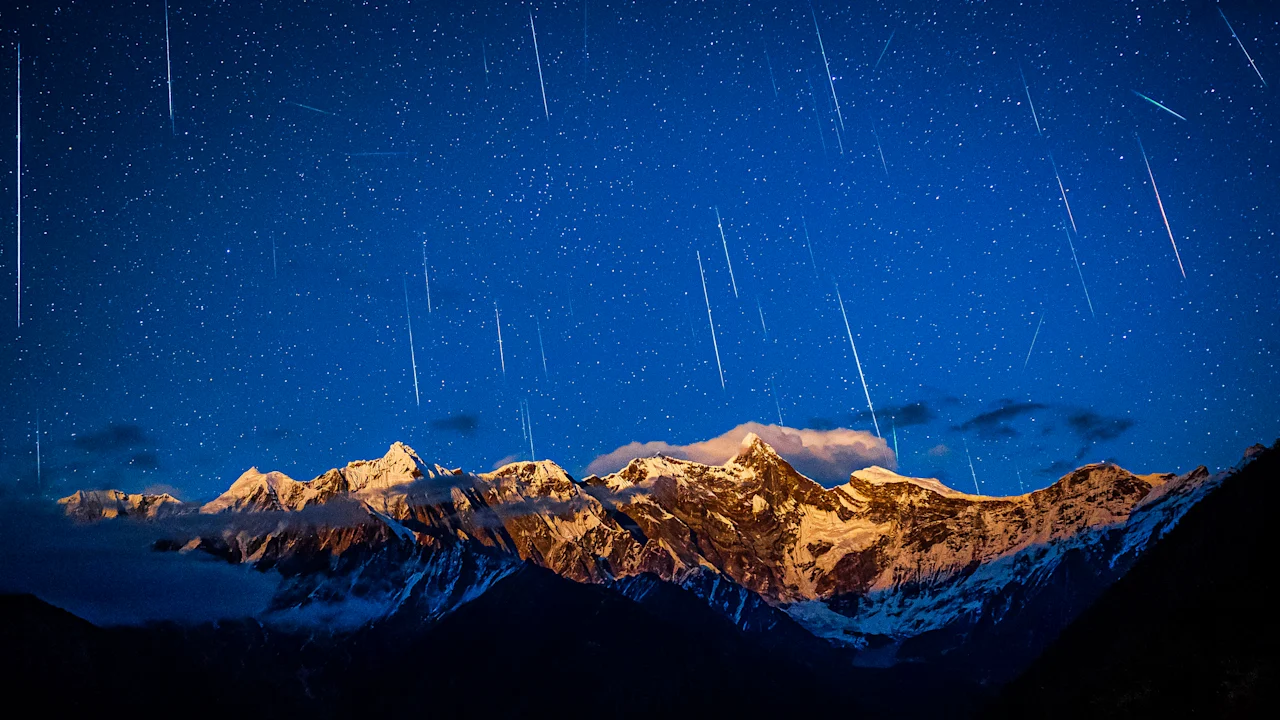
Geminids peak 2025: A meteor shower will light up the December sky tonight. Here’s what time to look up
If the holiday hustle and bustle is stressing you out, the night sky is providing a perfect moment to pause and wonder at some majesty this weekend, as the Geminid meteor shower is set to peak.
The Geminids are technically active annually—this year, from around December 1 through 21, and the action peaks on the evenings of the 12th and 13th.
Let’s take a look at the science and history behind this cosmic phenomenon, and then dive into how best to view it.
When was the Geminid meteor shower first discovered?
These days, the Geminid meteor shower is considered by NASA to be “one of the best and most reliable annual meteor showers.”
The event started much smaller. The meteors were first observed in the mid-1800s and only boasted 10 to 20 meteors an hour. As time went on, Jupiter got in on the action. The planet’s gravity pulled the show closer to Earth.
What causes the Geminids?
It wasn’t until the 1980s that scientists understood the cause of the meteor shower was asteroid 3200 Phaethon. Typically, meteor showers are caused by a comet. Asteroid 3200 Phaethon acts like a comet, despite most asteroids taking 1.4 years to fully orbit the sun. Scientists are still learning about this unique space object. A 2023 article, published in The Planetary Science Journal by California Institute of Technology PhD student Qicheng Zhang, stated that when the asteroid approaches the sun, it forms a sodium-gas tail instead of dust.
This challenges earlier beliefs about the object. It is now hypothesized that the dense Geminid meteoroids are a result of a possible past mass loss, not an ongoing tail shedding around the sun.
Regardless, the average person will delight in the vivid burst of light as the meteoroids burn up in Earth’s atmosphere.
How best to see the Geminids
Scientists and night-sky enthusiasts can agree that whatever label you assign 3200 Phaethon, it puts on one heck of a show. This year’s offerings are best seen in the Northern Hemisphere, though some meteors will be visible from the Southern Hemisphere as well.
The moon is also cooperating, as it will be in its waning crescent moon phase and not shining too brightly.
When nightfall comes on December 12 and 13, find the darkest place you can, away from city lights. Special viewing equipment such as binoculars or telescopes are not necessary—especially since meteors move quickly.
The action originates around the Gemini constellation, but you should not just focus there. Look at the entire night sky.
If you do miss the peak viewing time, the days around the December 12 and 13 peak should still offer quite a show.
Originally published by fastcompany.com. Syndicated material does not necessarily reflect the views of Grazia British.
More Culture

Don’t Pull Out of Germany
Merz’s stupidity is no excuse for a stupid response. Source link

Step inside the gorgeous, futuristic offices of Vast, the startup designing the next-gen space station
A tall baobab tree greets people inside the Long Beach, California, headquarters of Vast, an aerospace company that is building the space station of the future. It’s planted beneath a…
5 ways high-performing teams stay calm when everything’s on fire
When markets swing, plans break, inboxes explode, and everyone starts saying the situation is “unprecedented” again, most teams do what humans have always done under pressure: they grip…

Confused Trump Openly Admits Plot to Rig Midterms as Polls Turn Brutal
Last week, the Supreme Court gutted protections against racial gerrymandering, and Donald Trump is already urging Republicans to seize on it. Trump unleashed a Truth Social rant on Monday…