
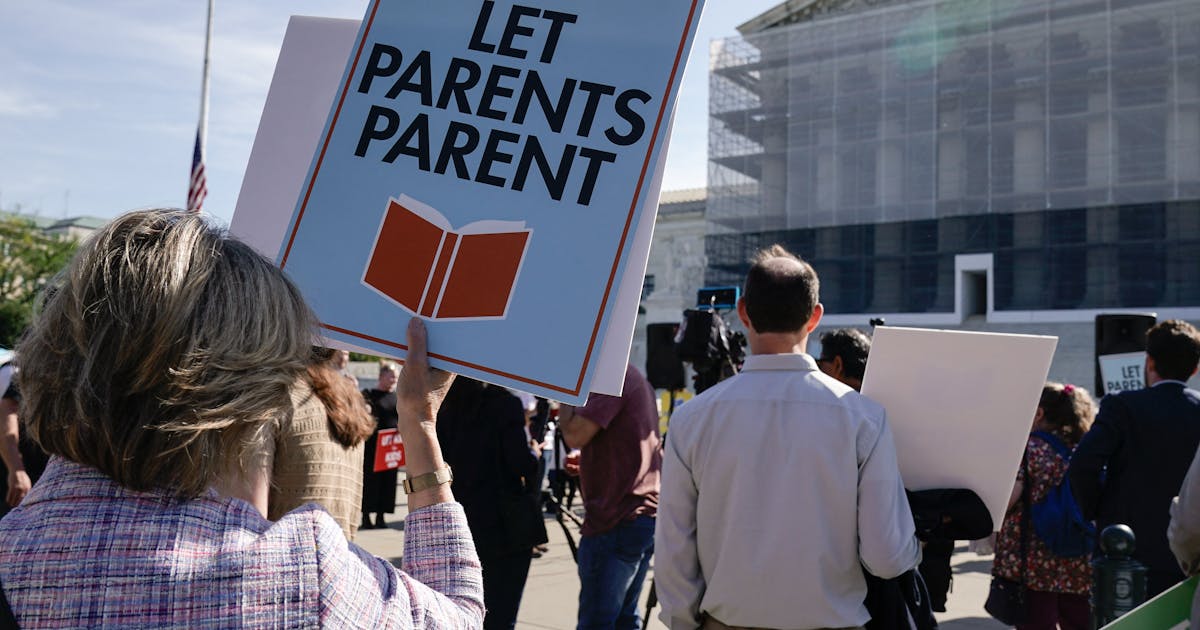
How Religious Pluralism Lost at the Supreme Court

The court’s conservative justices went out of their way to emphasize that Montgomery County, where some of them reside, is a bastion of religious tolerance and multiculturalism. Alito began his opinion by reciting this diversity in detail. “According to a recent survey, it is also the ‘most religiously diverse county’ in the nation,” he noted. “In addition to hosting a diverse mix of Christian denominations, the county ranks in the top five in the nation in per-capita population of Jews, Muslims, Hindus, and Buddhists. The county’s religious diversity is accompanied by strong cultural diversity as well.”
Justice Brett Kavanaugh, a Montgomery County native, also emphasized the county’s pluralistic nature during oral arguments. “Maryland was founded on religious liberty and religious tolerance, a haven for Catholics escaping persecution in England going back to 1649,” he told Alan Schoenfeld, the lawyer who represented the board. “I’m sure you’re aware of this history. And Montgomery County has been a beacon of that religious liberty for all these years with a strong Catholic population, a substantial Jewish population, lots of different Protestants. I mean, you drive down Connecticut Avenue or Georgia Avenue, you see religious building after religious building. And I guess I’m surprised that this is the hill we’re going to die on in terms of not respecting religious liberty, given that history.”
Montgomery County’s diversity and history of religious tolerance and freedom is laudable. It is also the exception, not the rule. The Maryland county is also one of roughly 4,000 counties across the nation. As Alito himself noted, all but a handful of them are less religiously diverse than Montgomery County. And the issue at hand in Mahmoud—sexual orientation and gender identity—is one that unites members of some different faiths more easily than most topics.
So while the case’s fact pattern will be an outlier in the national experience, the outcome that it imposes will be universal. The ruling is most likely to benefit the majority and plurality faiths in a given school district. Members of those faiths could already influence their local curriculum through the democratic process. But if they were somehow not able to do so, they will now almost certainly be able to shape it through the de facto veto that the Supreme Court has given them. Their power and influence over the rest of the student body is now greatly expanded.
Originally published by newrepublic.com. Syndicated material does not necessarily reflect the views of Grazia British.
More Culture

Don’t Pull Out of Germany
Merz’s stupidity is no excuse for a stupid response. Source link

Step inside the gorgeous, futuristic offices of Vast, the startup designing the next-gen space station
A tall baobab tree greets people inside the Long Beach, California, headquarters of Vast, an aerospace company that is building the space station of the future. It’s planted beneath a…

5 ways high-performing teams stay calm when everything’s on fire
When markets swing, plans break, inboxes explode, and everyone starts saying the situation is “unprecedented” again, most teams do what humans have always done under pressure: they grip…

Confused Trump Openly Admits Plot to Rig Midterms as Polls Turn Brutal
Last week, the Supreme Court gutted protections against racial gerrymandering, and Donald Trump is already urging Republicans to seize on it. Trump unleashed a Truth Social rant on Monday…