
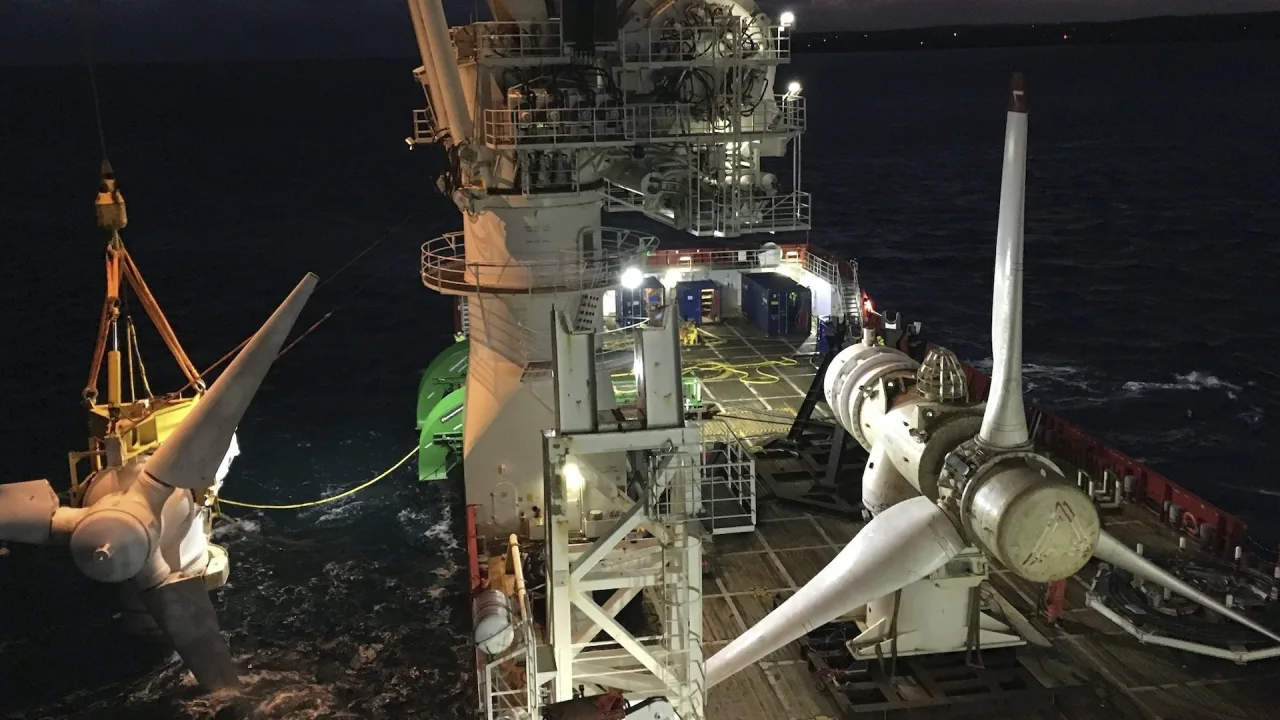
How Scotland’s underwater turbine is a breakthrough for tidal energy
Submerged in about 40 meters (44 yards) of water off Scotland’s coast, a turbine has been spinning for more than six years to harness the power of ocean tides for electricity — a durability mark that demonstrates the technology’s commercial viability.
Keeping a large, or grid-scale, turbine in place in the harsh sea environment that long is a record that helps pave the way for bigger tidal energy farms and makes it far more appealing to investors, according to the trade association Ocean Energy Europe. Tidal energy projects would be prohibitively expensive if the turbines had to be taken out of the water for maintenance every couple of years.
Tidal energy technologies are still in the early days of their commercial development, but their potential for generating clean energy is big. According to the National Renewable Energy Laboratory, marine energy, a term researchers use to refer to power generated from tides, currents, waves or temperature changes, is the world’s largest untapped renewable energy resource.
The MeyGen tidal energy project off the coast of Scotland has four turbines producing 1.5 megawatts each, enough electricity collectively to power up to 7,000 homes annually. On Thursday, the Swedish company SKF announced that its bearings and seals on one of the turbines had passed the 6 1/2-year mark without needing unplanned or disruptive maintenance. It has been working closely with the industry for a decade on design and testing.
Achieving six years in the water with constant operations is a “very significant milestone” that bodes well for the future of tidal energy, said Rémi Gruet, CEO of Ocean Energy Europe.
Scotland and the United Kingdom are global leaders in tidal energy. The MeyGen site, operated by SAE Renewables, has been sending electricity to the grid for about eight years.
There are very few tidal energy projects generating electricity continuously. Most have been tests and demonstrations, said Andrea Copping, an expert in marine renewable energy development. Copping said there are still large hurdles to overcome before tidal energy can be adopted more widely, such as dealing with regulatory issues, potential environmental effects and conflicts with other ocean users.
Still, the Scotland project seems to have addressed the question of whether the turbines can last in seawater, added Copping, a distinguished faculty fellow in the School of Marine and Environmental Affairs at the University of Washington.
“I think they have checked the boxes,” she said. “Because skeptics, and that includes investors of course and governments, said, ‘How on Earth are you going to operate these things especially for any length of time in this very tough environment?’ And that’s what I think they proved.”
It’s very hard to take what is essentially a wind turbine normally found on land and put it under water, said Fraser Johnson, operations and maintenance manager at MeyGen. The record-setting turbine should keep going for at least another year before it needs to come out of the water for maintenance, he added.
The four turbines are in the Inner Sound of the Pentland Firth, a narrow channel between the Scottish mainland and Stroma Island known for strong tidal currents. Tidal energy systems need strong currents to make electricity efficiently. MeyGen plans to add 20 turbines in 2030 to produce more electricity, after needed upgrades to the electricity grid are finished. The site could eventually hold as many as 130 turbines that are more powerful than those at the site today.
The MeyGen site is in the open water, while another type of tidal project involves creating a dam-like structure called a barrage across tidal waters. With four turbines, MeyGen is considered the largest tidal energy project of its kind worldwide, said Johnson.
“It’s a title we wish we didn’t have. We want more, we want others,” he said. “Unfortunately others are having difficulty achieving what MeyGen has achieved. But working with SKF moving forward, we’ll push the industry forward.”
___
The Associated Press’ climate and environmental coverage receives financial support from multiple private foundations. AP is solely responsible for all content. Find AP’s standards for working with philanthropies, a list of supporters and funded coverage areas at AP.org.
—Jennifer McDermott, Associated Press
Originally published by fastcompany.com. Syndicated material does not necessarily reflect the views of Grazia British.
More Culture

Don’t Pull Out of Germany
Merz’s stupidity is no excuse for a stupid response. Source link

Step inside the gorgeous, futuristic offices of Vast, the startup designing the next-gen space station
A tall baobab tree greets people inside the Long Beach, California, headquarters of Vast, an aerospace company that is building the space station of the future. It’s planted beneath a…

5 ways high-performing teams stay calm when everything’s on fire
When markets swing, plans break, inboxes explode, and everyone starts saying the situation is “unprecedented” again, most teams do what humans have always done under pressure: they grip…

Confused Trump Openly Admits Plot to Rig Midterms as Polls Turn Brutal
Last week, the Supreme Court gutted protections against racial gerrymandering, and Donald Trump is already urging Republicans to seize on it. Trump unleashed a Truth Social rant on Monday…