

How the New Food Pyramid Fits Into the Broader Conservative Project
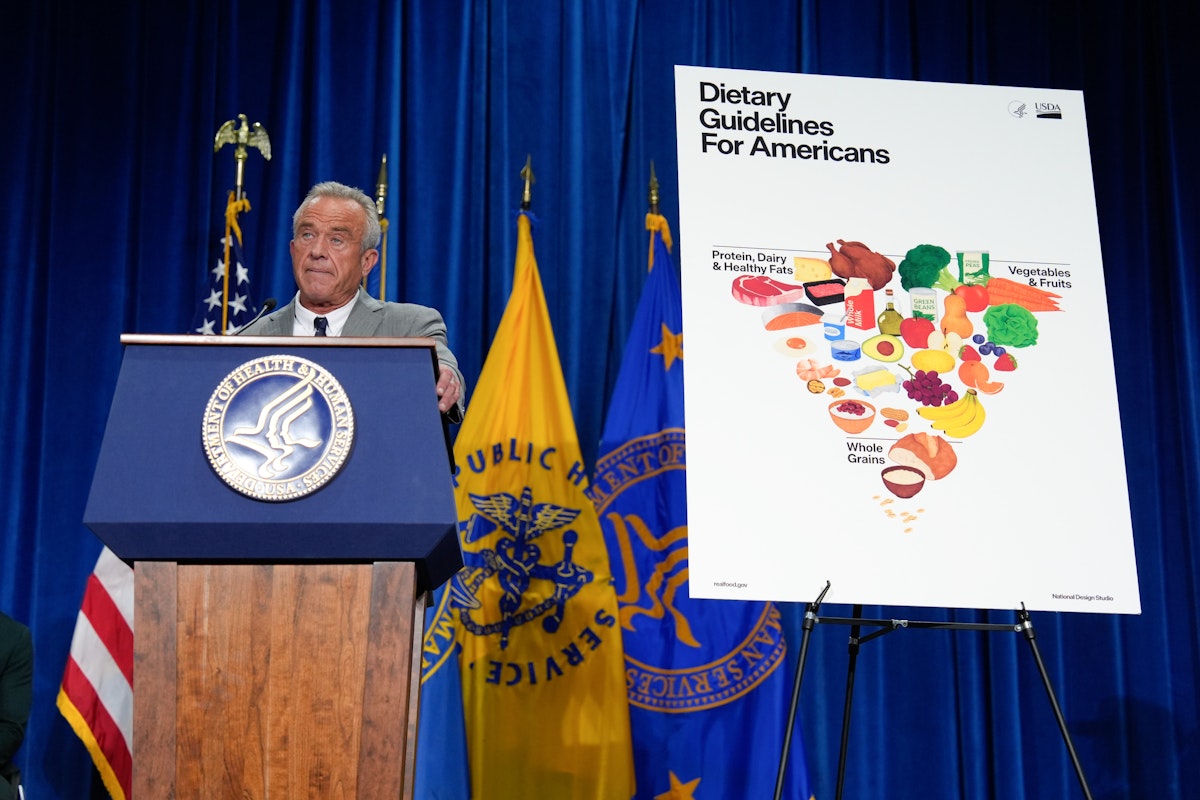
The Agriculture Department’s new-look food pyramid, released last week to accompany a new set of Dietary Guidelines for Americans, appears more like a minimalist poster designed to be hung in a foodie’s kitchen than a piece of government policy. Underneath the invitation to “Eat Real Food,” the inverted pyramid is made up of drawings of diverse foods grouped into three categories: protein, dairy, and healthy fats; vegetables and fruits; and whole grains. On its surface, innocuous. But a closer look reveals a piece of ideological art designed to upset the consensus on healthy eating and, perhaps, own the libs. The eye goes first to the fat cut of steak, then the wedge of cheese, a whole roast turkey, a package of ground beef, a carton of whole milk, then a bounty of fruits and vegetables that brings one down to an unwrapped stick of butter, and finally, at the bottom, brown and unappealing, a loaf of sourdough bread and a bowl of oatmeal. Given previous guidelines’ slow drift away from meaty and cheesy diets in line with expert consensus, these guidelines are less of a public health intervention and more of a meme: a message to the political and cultural constituencies like the MAHA moms and the carnivorous corners of the manosphere.
The USDA has been releasing dietary guidelines since 1894 and visually representing them for the public since 1943. It began with a color-coded circle made up of the “Basic 7” food groups, urging Americans to eat from each one every day. This was replaced in 1955 with a “daily food guide” made up of the four food groups that remain etched into contemporary nutrition discourse: milk, meat, fruits and vegetables, and bread and cereals. In 1977, the Senate Select Committee on Nutrition and Human Needs (commonly known as the McGovern Committee) recommended that Americans eat less refined sugar, red and fatty meat, dairy, and eggs, and more fruit and vegetables. In 1992, the “food pyramid” was introduced, schematizing five food groups—fruits and veggies were separated, beans and nuts added to meats to make a de facto “protein” category—as an ascending structure that should guide daily food consumption, accompanied by the introduction of daily recommended servings of each food group. This, in turn, was replaced in 2011 by MyPlate, a much-discussed reset that laid out the five food groups in proportional quantities on a plate as a heuristic for crafting healthy meals. Now the Trump administration has reintroduced the food pyramid, but turned it upside down—perhaps a little too on the nose.
Originally published by newrepublic.com. Syndicated material does not necessarily reflect the views of Grazia British.
More Culture

Don’t Pull Out of Germany
Merz’s stupidity is no excuse for a stupid response. Source link

Step inside the gorgeous, futuristic offices of Vast, the startup designing the next-gen space station
A tall baobab tree greets people inside the Long Beach, California, headquarters of Vast, an aerospace company that is building the space station of the future. It’s planted beneath a…

5 ways high-performing teams stay calm when everything’s on fire
When markets swing, plans break, inboxes explode, and everyone starts saying the situation is “unprecedented” again, most teams do what humans have always done under pressure: they grip…

Confused Trump Openly Admits Plot to Rig Midterms as Polls Turn Brutal
Last week, the Supreme Court gutted protections against racial gerrymandering, and Donald Trump is already urging Republicans to seize on it. Trump unleashed a Truth Social rant on Monday…