
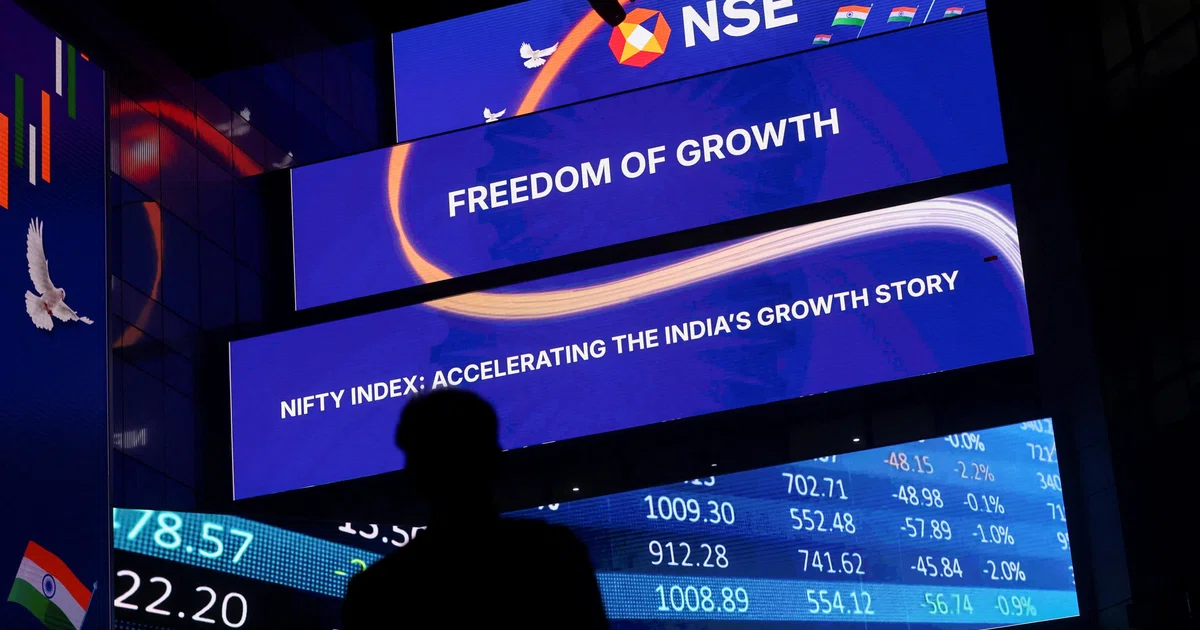
India's strong economic growth fails to impress equity investors
India’s world-beating economic growth is failing to translate into gains for equity markets as weakening pricing power and US tariffs weigh on corporate earnings, turning foreign investors away.
Gross domestic product (GDP) in India grew at a faster-than-expected 7.8 per cent in the April-June quarter in real terms. However, nominal growth, which represents output at current market prices, fell to 8.8 per cent from 10.8 per cent in the previous three months, indicating a drop in inflation.
This trend was also seen in corporate earnings, with revenue growth of the top 3,000 listed Indian companies slipping to a seven-quarter low of 3.4 per cent on-year, down from 5.1 per cent in the previous three months and 6.8 per cent a year ago, according to Mumbai-headquartered ICICI Bank Global Market Research.
“The core corporate earnings outlook is weak and for the next few quarters at least we remain underweight,” said Sat Dhura, portfolio manager at Janus Henderson Investors, adding that higher US tariffs are an impediment to growth that India cannot afford right now.
“Weaker credit growth, weaker nominal GDP growth and warnings of weakening asset quality at the banks will continue to keep foreign investors on the sidelines,” Dhura said.
Equity analysts in India see corporate earnings growth as more closely correlated with nominal growth. Slower nominal GDP growth translates into weaker corporate revenue and profits, which can make stocks look overvalued. Nominal GDP growth for the current financial year is expected to be 8.5 per cent-9 per cent, the lowest in two decades outside the Covid-19 pandemic, which could keep earnings and equity markets under pressure, analysts at Jefferies said in a report on Friday.
BT in your inbox

Start and end each day with the latest news stories and analyses delivered straight to your inbox.
India’s benchmark Nifty index has risen about 4 per cent so far this year, making it the third worst-performing across MSCI Asia countries this year, after Thailand and Indonesia. Foreign investors have sold a net US$15 billion in Indian equities so far, including US$4 billion in outflows in August, when US President Donald Trump hit India with tariffs of as much as 50 per cent.
Indian consumer staples struggled in the April-June quarter, with Hindustan Unilever reporting subdued revenue growth of 4 per cent and Colgate Palmolive India posting a 4 per cent decline.
“In our view, markets remain on the expensive side, and we expect the impact of tariffs to lead to further earnings downgrades over the next 1-2 months,” said Peeyush Mittal, portfolio manager at Matthews Asia.
“Accordingly, our near-term is cautious.”
Punitive tariffs are expected to lead to a 0.6-0.8 percentage point hit to real GDP growth if they stay in place for a year, according to economists.
But the indirect impact, via job losses in sectors like textiles and gems and jewellery, alongside a delay in investment plans could mean a more significant impact.
The underperformance of Indian markets relative to emerging market peers has narrowed the valuation gap, according to some fund managers who also expect domestic measures, such as tax cuts, to help improve earnings performance across consumer-oriented sectors.
“The current environment presents a potentially attractive entry point considering the pullback that started late last year has helped to deflate some of the frothy valuations – although India still trades near its long-term historical average,” said Rita Tahilramani, investment director of Asian equities at Aberdeen Investments.
Despite trading at premium valuations, India still offers compelling opportunities across key sectors from banking and infrastructure to domestic consumption, she said. Portfolio managers are also looking at plans to fast-track economic reforms, including a tax revamp, to revive spending.
Prime Minister Narendra Modi’s government will put to vote a proposal to reform its goods and services tax (GST) this week, which could help lift consumption of items from biscuits to air conditioners.
“Over the next six to 12 months, stronger consumption recovery could trigger a virtuous cycle of private capex and credit expansion,” said Hari Shyamsunder, senior institutional portfolio manager of Indian emerging markets equity at Franklin Templeton. REUTERS
Originally published by businesstimes.com.sg. Syndicated material does not necessarily reflect the views of Grazia British.
More Culture

Don’t Pull Out of Germany
Merz’s stupidity is no excuse for a stupid response. Source link

Step inside the gorgeous, futuristic offices of Vast, the startup designing the next-gen space station
A tall baobab tree greets people inside the Long Beach, California, headquarters of Vast, an aerospace company that is building the space station of the future. It’s planted beneath a…

5 ways high-performing teams stay calm when everything’s on fire
When markets swing, plans break, inboxes explode, and everyone starts saying the situation is “unprecedented” again, most teams do what humans have always done under pressure: they grip…

Confused Trump Openly Admits Plot to Rig Midterms as Polls Turn Brutal
Last week, the Supreme Court gutted protections against racial gerrymandering, and Donald Trump is already urging Republicans to seize on it. Trump unleashed a Truth Social rant on Monday…