
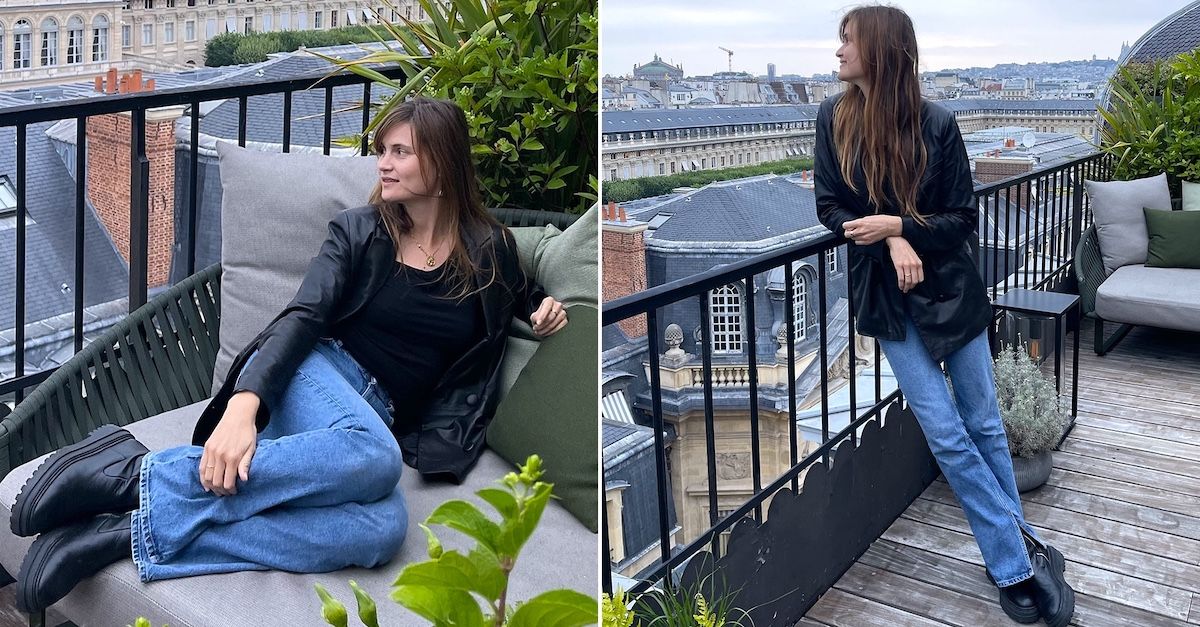
Is Being French Still a Style?
Eugénie Trochu is a Who What Wear editor in residence known for her transformative work at Vogue France and her Substack newsletter, where she documents and shares new trends, her no-nonsense approach to fashion and style, plus other musings. She's also working on her upcoming first book that explores fashion as a space of memory, projection, and reinvention.
Born in Normandy, I grew up in a France that still projected a very specific ideal of the French woman: thin, very thin, free, a little mysterious, with that mix of effortlessness and nonchalance that made the whole world fantasize about her. A woman somewhere between Jane Birkin, Caroline de Maigret, Jeanne Damas, and all those (mostly Parisian) women who embodied the beautiful but slightly frozen values of the “French woman” in all her supposed splendor.
A myth built on open men’s shirts, slightly tousled hair, half-faded red lipstick, Levi’s 501s, and that eternal “I got dressed in two minutes,” which, for once, was sometimes true.
I joined Vogue in 2011 and watched that myth begin to crack from the inside. It was beautiful, yes, but limiting. It claimed freedom while quietly excluding half the country. When I took over Vogue France ten years later, I wanted the magazine to tell a different story: not the French woman, but the French women. The ones who dress in Marseille, Lille, Bordeaux, Paris; those whose bodies, skin tones, heights, hair, and identities no longer fit into one single box.
The question “Is being French still a style?” often follows me, because it assumes there’s still one model. But that model, we’ve moved past it. French style is no longer a silhouette, it’s a conversation : a tension between heritage and modernity, between classicism and boldness. It’s the freedom to be contradictory, to wear vintage with Balenciaga, jeans with heirloom jewelry, to change your mind without warning.
The real French style in 2025 isn’t trench coat, striped top, and red lipstick. It’s an attitude: refusing to be defined. Rejecting the total look, the frozen narrative, the perfect image. It’s this idea that fashion isn’t a performance but a language, something that can be intimate, political, joyful, lazy, sometimes all at once.
And yet, something of the myth remains. There’s still a kind of distance in French culture, a refusal of excess. This “less is more” isn’t minimalism, it’s a quiet restraint that doesn’t suppress expression, but shapes it.
More Celebrity

James Quattrochi: From the Bronx to Hollywood — An Italian-American Story
Grazia British Exclusive For James Quattrochi, every role begins with authenticity. Raised in a proud Italian-American family near the legendary Arthur Avenue in the Bronx—New York City’s…

Puig and Fondazione Dries Van Noten Signed a 3-Year Partnership
CANAL PLUS: Spanish beauty and fashion firm Puig is further accompanying Dries Van Noten in his post-runway career, signing a three-year partnership with his new cultural venture in…

EXCLUSIVE: Dior Rolls Out New-look Dioriviera Beach Collection With Sailing-themed Pop-ups
PARIS — Dior is setting sail with a new-look Dioriviera line this summer, marking Jonathan Anderson’s first beach collection since taking over as creative director of the house last year.…

EXCLUSIVE: For NN.07, 2025 Was a Very Good Year
Not many fashion brands can crow about double-digit momentum these days, but Danish menswear firm NN.07 can. The Copenhagen-based company said net sales last year jumped 18 percent,…