
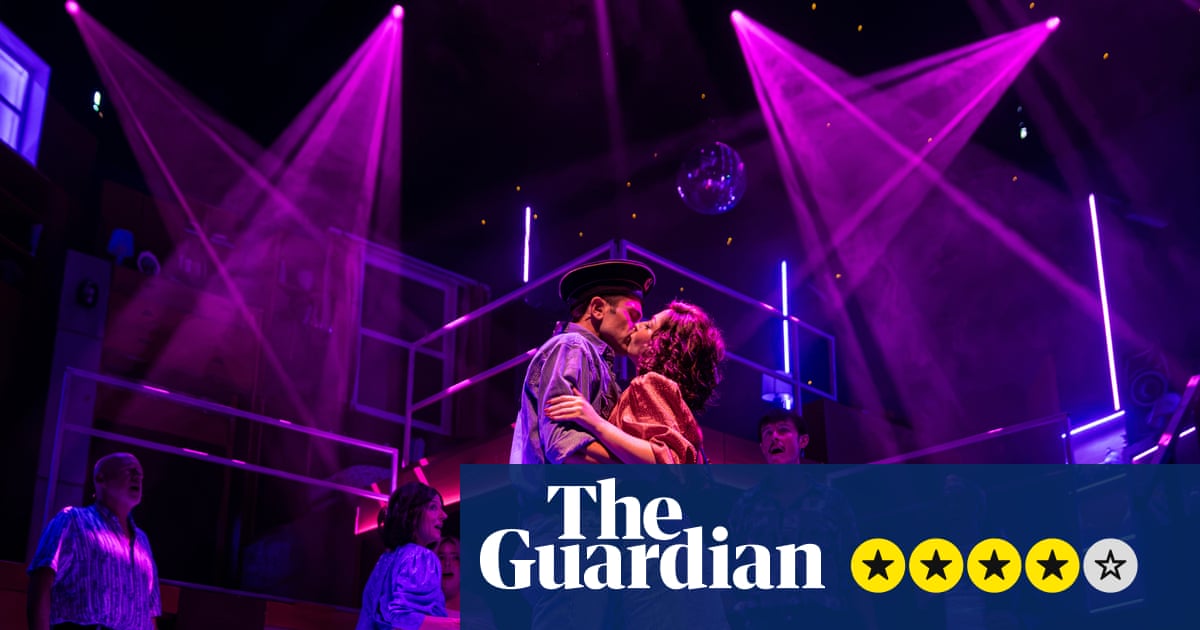
Letter to Brezhnev review – terrific return for Merseysiders’ romance with Russian sailors
By some quirk of marketing, Letter to Brezhnev is always associated with Margi Clarke. In the 1985 movie, she was the actor who played Teresa, the sharp-talking chicken-factory worker out for a good time in post-industrial Liverpool. The film, though, rightly belongs to Alexandra Pigg as Elaine, Teresa’s best friend, who trades a dead-end life of unemployment for a fantasy fling with a Russian sailor.
A few years before the collapse of the Soviet Union – and a year before Willy Russell’s similarly themed Shirley Valentine – Elaine dared to believe in escape and in border-defying love. On stage, she is played just as winningly by Ellie Clayton and with much the same combination of wit and wonder. She is the Kirkby girl who has a night on the town with a wallet of stolen cash and finds the world unexpectedly opening up to her. Elaine can be naive, petulant and cynical, but she never lets you stop rooting for her.
As Teresa, Angela Simms is the necessary corrective to Elaine’s dreamy romanticism: she lives for the moment and gives as good as she gets. Only in her quieter moments will she admit her rebelliousness is skin deep. They make a terrific pair.
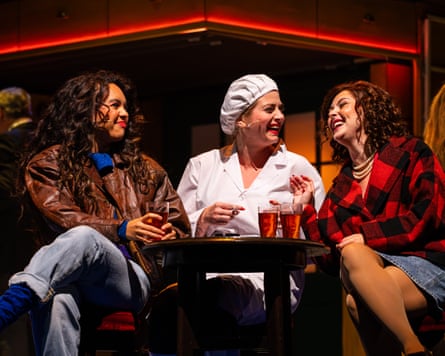
Frank Clarke’s if-it-ain’t-broke adaptation hugs closely to his original screenplay, adding the odd joke but sticking to the same sequence of taxi rides, club nights and ferry crossings. You might expect that to constrain the director – but no, Nicole Behan injects her production with tremendous energy, exchanging the movie’s subtle charm for ribald theatrical flair, drawing out the humour and the passion without diminishing the tender emotional heart.
The show takes shape around a multi-level set by Mark Walters, inventively lit by Ian Scott, with gangplanks, bedrooms and barbed wire neatly emerging from a towering frontage of wooden cupboards. In lesser hands it could dwarf the performers, but it is too cleverly conceived for that: something also true of Rob Green’s musical direction. At choice moments, he elevates the soundtrack of 70s and 80s hits by mixing in live vocals, whether it’s You Make Me Feel (Mighty Real) or Lips Like Sugar, showcasing an excellent ensemble.
Say what you like about movie adaptations, but with cast members from the film in the first-night audience, this one is joyfully at home on the stage.
Originally published by theguardian.com. Syndicated material does not necessarily reflect the views of Grazia British.
More Culture

Driver who killed woman celebrating 60th jailed
Donna Brighton was thrown into the road through the open window of a taxi, a court hears.
Polanski request to postpone Greens’ conference to focus on byelection refused by party
Exclusive: Leader understood to have wanted to concentrate on Holborn and St Pancras campaign in London but executive committee voted against plan
Flight chaos for hundreds of thousands was caused in ‘millisecond’ by software error
Error first occurred at 10am but major incident was not declared until 12.30pm, says report
Barbra Streisand blames Trump’s ‘unchecked ego’ for Kennedy Center chaos: ‘Painful to witness’
President announced this week that the arts institution would be shut down immediately for major renovations amid a legal battle over his name on the building