
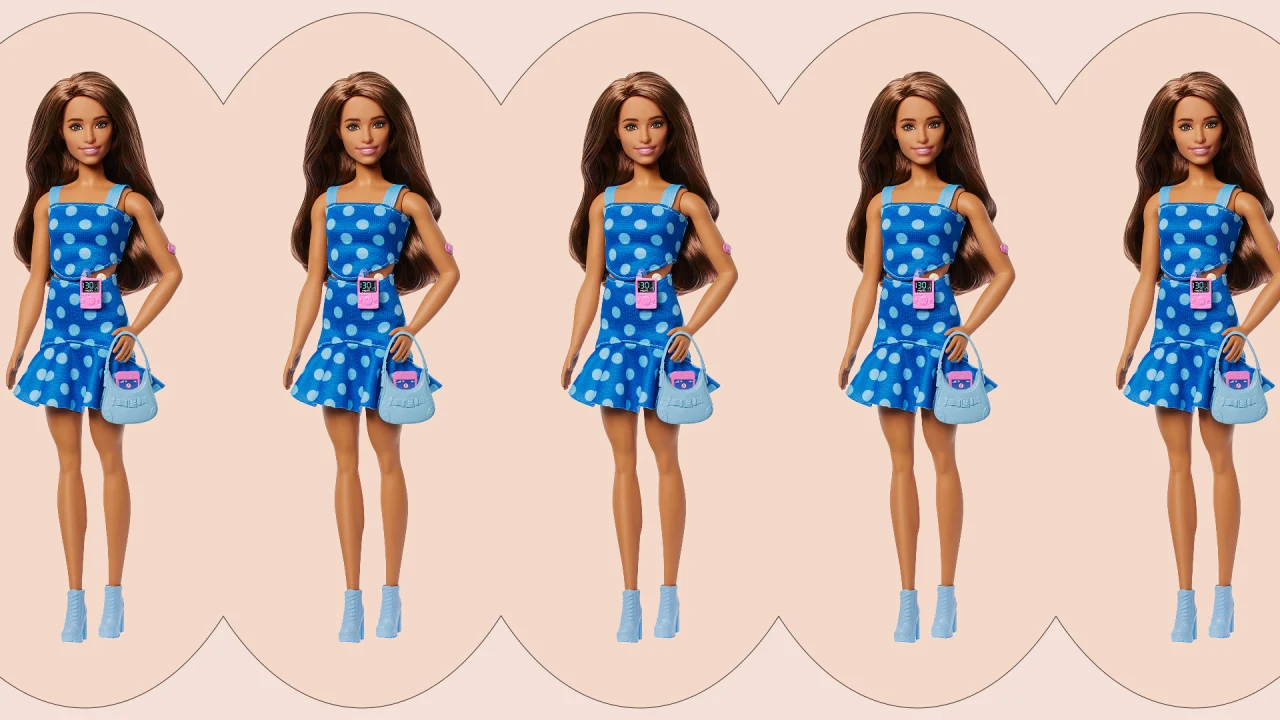
Mattel’s type 1 diabetes Barbie doll wears an insulin pump and glucose monitor. Here’s her origin story
Mattel has released its latest Barbie doll, and it’s a win for better representation.
The new Barbie doll visibly lives with type 1 diabetes, wearing an insulin pump and all. Along with the insulin pump around her waist, the doll has a Continuous Glucose Monitor on her arm—held in place with “Barbie pink” tape—and a phone displaying her blood sugar statistics.
The Barbie team worked with Breakthrough T1D, a research and advocacy organization, to design accurate-looking medical equipment. They also collaborated on the doll’s blue polka dot dress—a blue circle is the global symbol for diabetes awareness.
“More kids can see themselves”
“Introducing a Barbie doll with type 1 diabetes marks an important step in our commitment to inclusivity and representation,” Krista Berger, senior vice president of Barbie and global head of dolls, said in a statement. “Barbie helps shape children’s early perceptions of the world, and by reflecting medical conditions like T1D, we ensure more kids can see themselves in the stories they imagine and the dolls they love.”
The announcement coincided with Breakthrough T1D’s 2025 Children’s Congress from July 7 to 9, which featured a donation of Barbie dolls.
The Washington, D.C.-based event brings together over 170 children living with type 1 diabetes and gives them face time with members of the U.S. Congress. The event aims to garner ongoing funding for type 1 diabetes research.
Condition affects hundreds of thousands of U.S. children
Diabetes is a chronic condition in which a person’s body doesn’t produce enough insulin, causing their blood sugar levels to spike, according to the Centers for Disease Control and Prevention (CDC).
Individuals living with type 1 diabetes require insulin therapy and typically wear a pump attached to their skin at all times. The CDC reports that about 352,000 children live with diabetes in the United States—a majority of whom experience type 1 diabetes.
This number jumps to about 1.7 million when looking at individuals 20 or older who live with type 1 diabetes and use insulin.
Mattel has introduced other Barbies living with medical conditions in recent years. In 2019, the company released a Barbie who had a prosthetic leg and another who used a wheelchair. More recently, 2023 saw Mattel launch a Barbie living with Down syndrome.
In October 2024, Mattel reported a 17% dip in Barbie’s gross billings—despite the enormous success of the Oscar-winning Barbie movie the prior year. The company had hoped for a 3% increase in sales this year, but it pulled that guidance in May after uncertainty around tariffs.
Shares in Mattel Inc (NASDAQ: MAT) are up roughly 13% in 2025 so far.
Originally published by fastcompany.com. Syndicated material does not necessarily reflect the views of Grazia British.
More Culture

Don’t Pull Out of Germany
Merz’s stupidity is no excuse for a stupid response. Source link

Step inside the gorgeous, futuristic offices of Vast, the startup designing the next-gen space station
A tall baobab tree greets people inside the Long Beach, California, headquarters of Vast, an aerospace company that is building the space station of the future. It’s planted beneath a…

5 ways high-performing teams stay calm when everything’s on fire
When markets swing, plans break, inboxes explode, and everyone starts saying the situation is “unprecedented” again, most teams do what humans have always done under pressure: they grip…

Confused Trump Openly Admits Plot to Rig Midterms as Polls Turn Brutal
Last week, the Supreme Court gutted protections against racial gerrymandering, and Donald Trump is already urging Republicans to seize on it. Trump unleashed a Truth Social rant on Monday…