

NASA Telescope Finds 'Distorted' Galaxy That Looks Like a Question Mark
Astronomers in Canada used the James Webb Space Telescope — and a third time-and-space-bending galaxy cluster — to capture an image of two galaxies millions of lightyears away
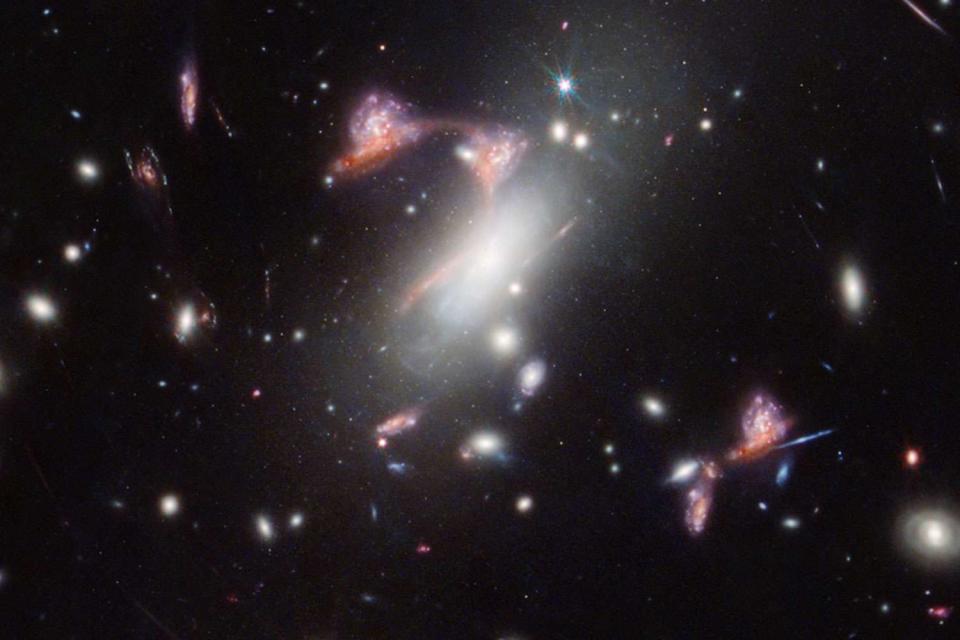
NASA has captured a new image of a question mark-shaped galaxy cluster light-ears away that astronomers say may be able to teach us about our own galaxy's past.
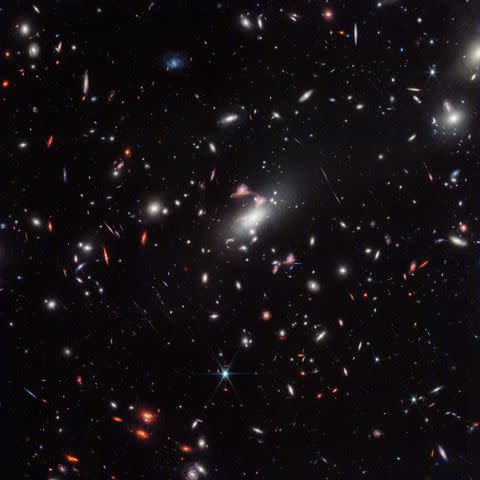
In a press release shared by the organization on Wednesday, Sept. 4, researchers announced that the James Webb Space Telescope was used to take clearer images of two distant galaxies that form a question mark shape when paired with a third galaxy cluster known as MACS-J0417.5-1154.
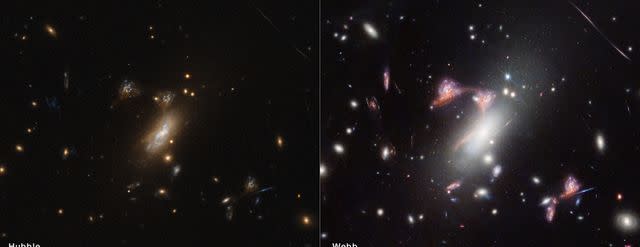
This dusty red galaxy has previously been photographed by NASA’s Hubble Space Telescope, but researchers utilized both the Webb and Hubble telescopes to take new images of it. According to NASA, astronomers used MACS-J0417.5-1154 as a sort of magnifying glass, because it's so large that it warps the fabric of space-time.
"This allows astronomers to see enhanced detail in much more distant galaxies behind the cluster. However, the same gravitational effects that magnify the galaxies also cause distortion, resulting in galaxies that appear smeared across the sky in arcs and even appear multiple times," NASA wrote in its press release. "These optical illusions in space are called gravitational lensing."
Because of these distortions, researchers said the galaxy captured by the telescope was interacting with a spiral galaxy (also previously detected by the Hubble), and the "unusual" magnification and distortion of the two galaxies made it look like they were appearing multiple times along the top of the question mark.
According to NASA, this unusual distortion is called a "hyperbolic umbilic gravitational lens," and it involves a "particular, rare alignment between the distant galaxies, the lens and the observer."
Never miss a story — sign up for PEOPLE's free daily newsletter to stay up-to-date on the best of what PEOPLE has to offer, from celebrity news to compelling human interest stories.
"We know of only three or four occurrences of similar gravitational lens configurations in the observable universe, which makes this find exciting, as it demonstrates the power of Webb and suggests maybe now we will find more of these," said astronomer Guillaume Desprez, a member of the team presenting the Webb results from Saint Mary’s University in Canada.
NASA added that the dot of the question mark is an unrelated galaxy that simply happened to be "in the right place and space-time, from our perspective."
The organization noted that these images and data were obtained as a part of a case study to determine how well the Webb NIRISS (Near-Infrared Imager and Slitless Spectrograph) instrument could gather information about star formations millions of lightyears away, and the question mark was a "cool" addition.
Related: Starliner Capsule Begins Return to Earth Without Crew, Who Will Remain in Space
"This is just cool looking. Amazing images like this are why I got into astronomy when I was young," said lead astronomer Marcin Sawicki, also of Saint Mary’s University.
"Knowing when, where and how star formation occurs within galaxies is crucial to understanding how galaxies have evolved over the history of the universe," fellow St. Mary's astronomer Vicente Estrada-Carpenter added.
According to Estrada-Carpenter, the two galaxies spotted via MACS-J0417.5-1154 are at the early stages of interacting with each other, likely the result of them colliding.
"These galaxies, seen billions of years ago when star formation was at its peak, are similar to the mass that the Milky Way galaxy would have been at that time. Webb is allowing us to study what the teenage years of our own galaxy would have been like," Sawicki added.
For more People news, make sure to sign up for our newsletter!
Read the original article on People.
Originally published by yahoo.com. Syndicated material does not necessarily reflect the views of Grazia British.
More Culture

Don’t Pull Out of Germany
Merz’s stupidity is no excuse for a stupid response. Source link

Step inside the gorgeous, futuristic offices of Vast, the startup designing the next-gen space station
A tall baobab tree greets people inside the Long Beach, California, headquarters of Vast, an aerospace company that is building the space station of the future. It’s planted beneath a…
5 ways high-performing teams stay calm when everything’s on fire
When markets swing, plans break, inboxes explode, and everyone starts saying the situation is “unprecedented” again, most teams do what humans have always done under pressure: they grip…

Confused Trump Openly Admits Plot to Rig Midterms as Polls Turn Brutal
Last week, the Supreme Court gutted protections against racial gerrymandering, and Donald Trump is already urging Republicans to seize on it. Trump unleashed a Truth Social rant on Monday…