
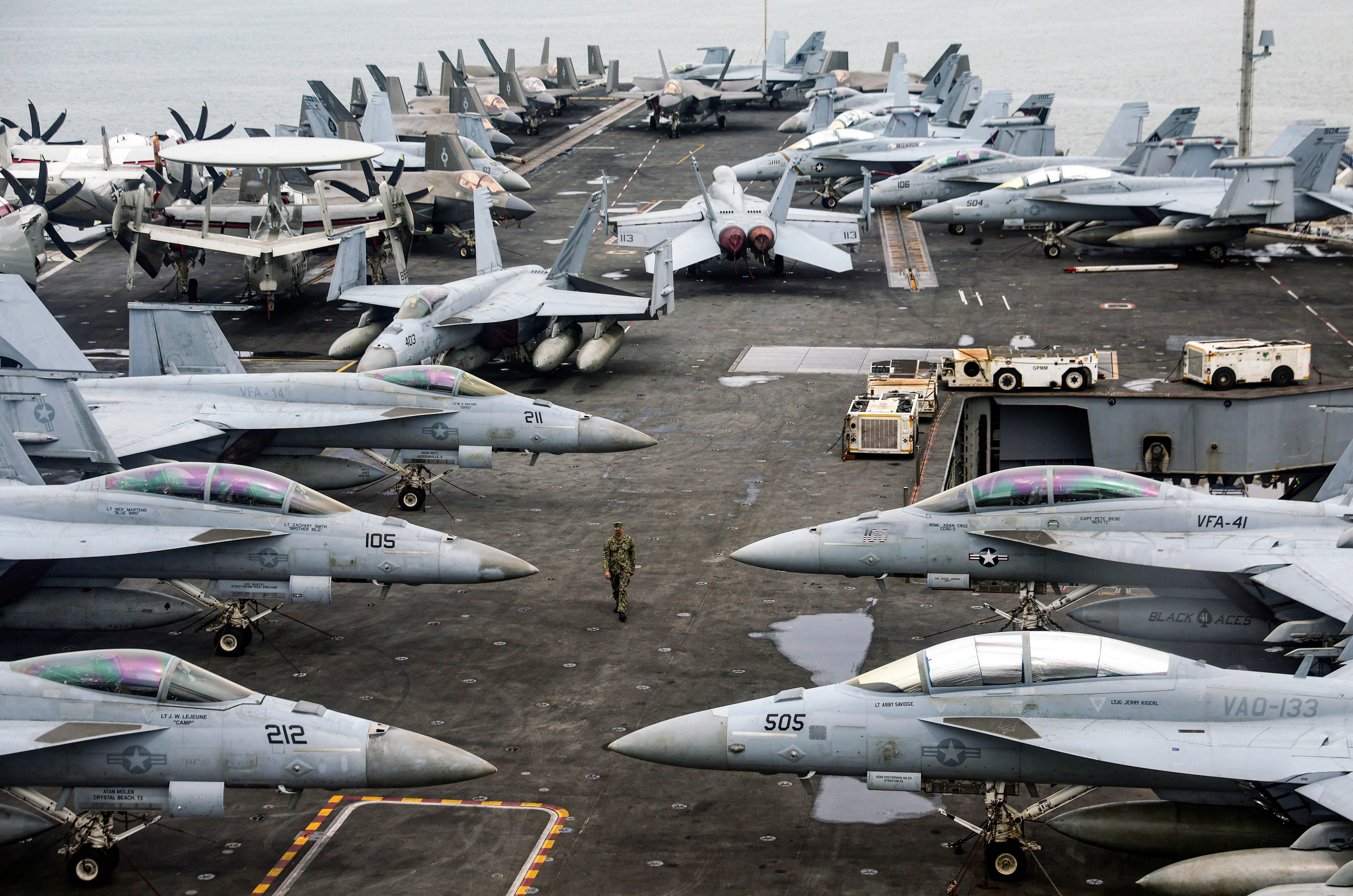
NATO's defense vulnerable to China's control over seven materials
What's New
NATO's military capabilities face significant risks from China's near-total dominance in seven critical materials essential to defense technologies.
Newsweek reached out to the Chinese Foreign Ministry and U.S. Department of Defense by email with a request for comment.
Why It Matters
Earlier this month, NATO's 32-member defense grouping published a report identifying "12 defense-critical raw materials essential for the Allied defense industry." These materials include aluminum, beryllium, cobalt, gallium, germanium, graphite, lithium, manganese, platinum, rare earth elements, titanium, and tungsten.
China dominates the production and processing of several of these materials, giving it leverage over key components of U.S. and its allies' defense technologies as Beijing strengthens its strategic alignment with Russia and continues to supplant Washington as the predominant military power in the West Pacific.
What To Know
China's control is most pronounced in materials like gallium, accounting for 98 percent of global production. Gallium is vital for manufacturing high-performance microchips used in cutting-edge military technologies such as advanced radar systems and missile guidance platforms.
The country also produces 60 percent of the world's germanium, indispensable for infrared optics like night-vision devices and laser targeting systems. Similarly, China controls over 70 percent of global graphite production, essential for batteries in helicopters, missiles, and other defense platforms.
In retaliation for U.S. export restrictions on advanced chip technologies, China last year imposed curbs on exporting gallium, germanium, and graphite to the U.S., intensifying the vulnerability.
China has also enacted export controls on tungsten, a super-dense metal used in armor-piercing munitions, and titanium, critical for aircraft frames and propeller shafts due to its high strength and corrosion resistance.
The country's dominance in rare earth elements (REEs)—a group of 17 critical minerals—further compounds NATO's strategic concerns. REEs are foundational to modern defense technologies, including precision-guided weapons, stealth platforms, and advanced communication systems.
While China controls 55 percent of global aluminum production, the material's strength-to-weight ratio makes it vital for constructing aircraft frames, naval hulls, and missile systems.
For cobalt and lithium, China produces far less raw material but dominates their refining processes, accounting for 68 and 72 percent of global capacity in 2022, respectively. These materials are crucial for jet engines, drone batteries, and other military systems.
What People Are Saying
NATO: "The availability and secure supply of these materials are vital to maintaining NATO's technological edge and operational readiness... Identifying these key materials is NATO's first step towards building stronger, better protected supply chains, crucial for Allied defense and security."
Center for Strategic and International Studies: "In terms of strengthening military preparedness, China is operating in a wartime posture while the United States is operating in a peacetime posture. Even prior to the new restrictions, the U.S. defense industrial base lacked the capacity and surge capabilities to meet defense technology production needs.
"Bans on vital mineral inputs will only further allow China to outpace the United States in building these capabilities."
What Happens Next
China's dominance over these strategic materials has alarmed policymakers in Washington. In response, the House Select Committee on the Chinese Communist Party has launched a working group to reduce U.S. reliance on China for critical minerals.
Last week, China's Commerce Ministry announced new controls on gallium, germanium, and tungsten as well as antimony and "superhard materials." The move was widely interpreted as a warning to the incoming administration of President-elect Donald Trump, who has pledged to further ramp up tariffs on Chinese goods.
Originally published by newsweek.com. Syndicated material does not necessarily reflect the views of Grazia British.
More Lifestyle

Millennium Docs Against Gravity Festival Director on How Documentary Film Helps Audiences Find ‘Sense Amid the Chaos’ of Current Events
Poland’s Millennium Docs Against Gravity, the documentary film festival that takes place simultaneously across seven Polish cities, returns for its 23rd edition from May 7 – 17 with a…

Mubi Acquires Na Hong-Jin’s Korean Thriller ‘Hope,’ Starring Michael Fassbender, Alicia Vikander and Hoyeon, For Multiple Territories Ahead of Cannes Premiere
Mubi is once again flexing it financial muscle ahead of Cannes, picking up one of the buzziest films heading to this year’s festival. The arthouse distributor and production company has…

MetFilm Sales Acquires Mongolian Documentary ‘Colors of White Rock’ Ahead of World Premiere at Tribeca (EXCLUSIVE)
London-based MetFilm Sales has acquired Mongolian filmmaker Khoroldorj Choijoovanchig’s debut feature documentary “Colors of White Rock” for worldwide sales representation. The film will…

Brit Detective Drama ‘Bergerac’ Bought for U.S. by PBS Distribution (EXCLUSIVE)
British detective drama “Bergerac” is heading to the U.S. with PBS Distribution following a deal with Banijay Rights. The acquisition comes ahead of next week’s London TV Screenings, with…