
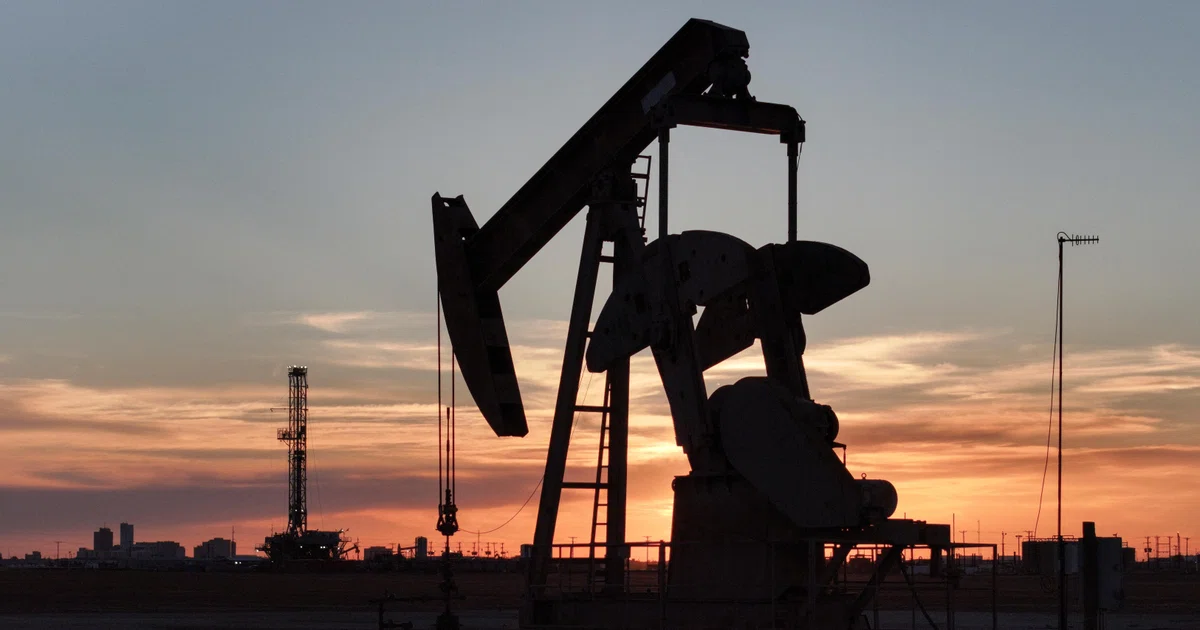
Oil settles lower as traders gauge Middle East tensions
Oil prices settled slightly lower on Thursday as traders booked profits from a 4 per cent rally in the prior session, driven by concerns that worsening tensions in the Middle East could cause supply disruptions.
Brent crude futures settled down 41 cents, or 0.6 per cent, at US$69.36 a barrel. US West Texas Intermediate crude fell 11 cents, or 0.2 per cent, to settle at US$67.97 a barrel.
US President Donald Trump on Thursday said an Israeli strike on Iran “could very well happen,” but added that he would not call it imminent and prefers to avoid conflict.
The US had earlier decided to move personnel out of the Middle East, sending both crude oil benchmarks up more than 4 per cent to their highest since early April on Wednesday.
The surge put the market in overbought territory based on several technical indicators, so it was likely due for a brief correction, StoneX Energy analyst Alex Hodes said.
US and Iranian officials were scheduled to hold a sixth round of talks on Tehran’s uranium enrichment programme in Oman on Sunday, according to officials from both countries and their Omani mediators.
BT in your inbox

Start and end each day with the latest news stories and analyses delivered straight to your inbox.
Trump has repeatedly threatened strikes against Iran if the nuclear talks fail to reach an agreement. Tehran, which asserts its nuclear activity is for peaceful purposes, has said it would retaliate against strikes by hitting US bases in the region.
Rising tensions in the region have oil traders worried about possible supply disruptions.
Britain’s maritime agency warned on Wednesday that increased tensions in the Middle East may escalate military activity and impact shipping in critical waterways.
“For the oil market, the absolute nightmare is a closure of the Strait of Hormuz,” Arne Rasmussen, an analyst at Global Risk Management, said in a LinkedIn post.
“If Iran blocks this narrow chokepoint, it could affect up to 20% of global oil flows,” he added.
JPMorgan said oil prices could surge to US$120 to US$130 a barrel if the Strait of Hormuz were to be shut, a scenario the bank considered to be severe but a low risk.
Still, oil traders were growing cautious.
“We are still higher than two days ago as some short investors prefer to stay on the sidelines amid the uncertainty,” said Giovanni Staunovo, an analyst at UBS.
US special envoy Steve Witkoff plans to meet Iranian Foreign Minister Abbas Araghchi in Oman on Sunday to discuss Iran’s response to a US proposal for a deal.
The UN nuclear watchdog’s 35-nation Board of Governors declared Iran in breach of its non-proliferation obligations on Thursday for the first time in almost 20 years, raising the prospect of reporting it to the UN Security Council. REUTERS
Originally published by businesstimes.com.sg. Syndicated material does not necessarily reflect the views of Grazia British.
More Culture

Don’t Pull Out of Germany
Merz’s stupidity is no excuse for a stupid response. Source link

Step inside the gorgeous, futuristic offices of Vast, the startup designing the next-gen space station
A tall baobab tree greets people inside the Long Beach, California, headquarters of Vast, an aerospace company that is building the space station of the future. It’s planted beneath a…

5 ways high-performing teams stay calm when everything’s on fire
When markets swing, plans break, inboxes explode, and everyone starts saying the situation is “unprecedented” again, most teams do what humans have always done under pressure: they grip…

Confused Trump Openly Admits Plot to Rig Midterms as Polls Turn Brutal
Last week, the Supreme Court gutted protections against racial gerrymandering, and Donald Trump is already urging Republicans to seize on it. Trump unleashed a Truth Social rant on Monday…