
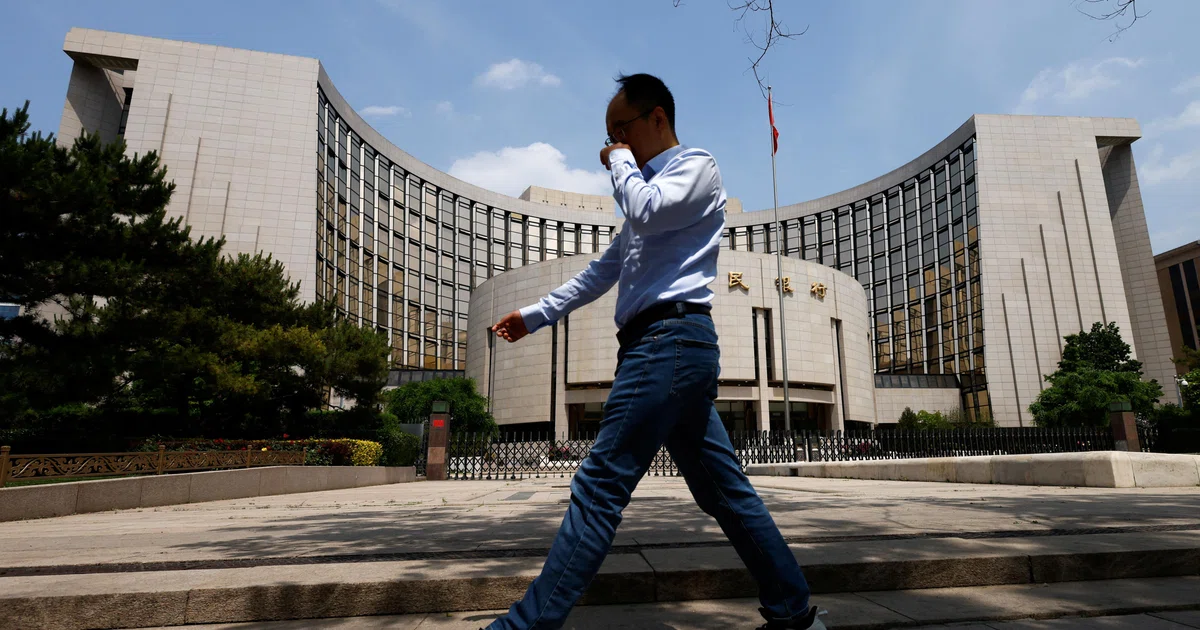
PBOC adviser urges 1.5 trillion yuan stimulus to counter US tariffs
China should add as much as 1.5 trillion yuan (S$268 billion) in fresh stimulus to boost consumer spending and maintain currency flexibility to counter US tariffs’ drag on growth, academics including an adviser to the country’s central bank said.
The Chinese economy has been facing “new disruptions” since April, when US levies jumped, in addition to persistent deflation, Huang Yiping, a member of the monetary policy committee of the People’s Bank of China (PBOC), and two other experts wrote in a report published on Friday (Jul 11).
“To address these evolving challenges, China must adopt a more forceful counter-cyclical approach to maintain stable growth, while advancing aggressively with structural reforms,” said the authors, who include Guo Kai, a former PBOC official, and Alfred Schipke, director of the East Asian Institute at the National University of Singapore.
The authorities should consider an additional one trillion yuan to 1.5 trillion yuan package over 12 months to lift household consumption to mitigate damages on the economy from 20 to 30 per cent US tariffs, they wrote. That compares with 300 billion yuan that central authorities plan to borrow this year by selling ultra-long sovereign special bonds to subsidise consumer purchases in its flagship initiative to boost spending.
Economists broadly expect Beijing to ease policies further in the coming months to shield the economy from a potential slump in exports due to US President Donald Trump’s tariffs and Washington’s tightening scrutiny over the rerouting of Chinese shipments. Domestically, the property market is still struggling and deflationary pressures are building as businesses cut prices to keep customers.
Huang and his colleagues also see room for the PBOC to cut policy rates further and guide banks to lower the Loan Prime Rates to help bolster expectations of stronger nominal growth, which is key for corporate profits. They suggest that the central bank to maintain “sufficient” flexibility in the yuan to absorb future external shocks.
Over the longer term, the government needs to expand the personal income tax base and simplify value-added tax structures in part of the reforms to ensure fiscal sustainability, they said.
They also called for managing risks associated with loans to small- and medium-sized enterprises (SMEs) to free up banks’ capacity to extend new credit to more productive sectors.
After years of policies to encourage lending to SMEs and extended repayment deadlines, outstanding loans to the group now exceed 60 per cent of China’s gross domestic product, up from 37 per cent in 2019 and surpassing exposures to local government financing vehicles, they said. BLOOMBERG
Originally published by businesstimes.com.sg. Syndicated material does not necessarily reflect the views of Grazia British.
More Culture

Don’t Pull Out of Germany
Merz’s stupidity is no excuse for a stupid response. Source link

Step inside the gorgeous, futuristic offices of Vast, the startup designing the next-gen space station
A tall baobab tree greets people inside the Long Beach, California, headquarters of Vast, an aerospace company that is building the space station of the future. It’s planted beneath a…

5 ways high-performing teams stay calm when everything’s on fire
When markets swing, plans break, inboxes explode, and everyone starts saying the situation is “unprecedented” again, most teams do what humans have always done under pressure: they grip…

Confused Trump Openly Admits Plot to Rig Midterms as Polls Turn Brutal
Last week, the Supreme Court gutted protections against racial gerrymandering, and Donald Trump is already urging Republicans to seize on it. Trump unleashed a Truth Social rant on Monday…