

Pre-Hispanic pyramid structure discovered during roadwork in Mexico
Roadwork uncovered a large pyramid-shaped structure dated to pre-Hispanic times in Mexico, the country's National Institute of Anthropology and History (INAH) announced.
The structure, described as a pyramidal base, was identified in the Sierra Alta region of the central state of Hidalgo, which is north of Mexico City. In archaeology, the term "pyramidal base" refers to the foundations or the lower part of a pyramid structure.
Pyramids in Mesoamerica, such as those built by the Maya, Aztec and Teotihuacán civilizations, were monumental structures often used for religious and ceremonial purposes. These pyramids, characterized by their stepped design and central staircases, often served as temples and were frequently the centerpieces of ancient cities.
Mesoamerica is a historical and cultural region in North America that extends from central Mexico through Belize, Guatemala, El Salvador, Honduras, Nicaragua and northern Costa Rica. It is known for being the cradle of several advanced pre-Hispanic (or pre-Columbian) civilizations.
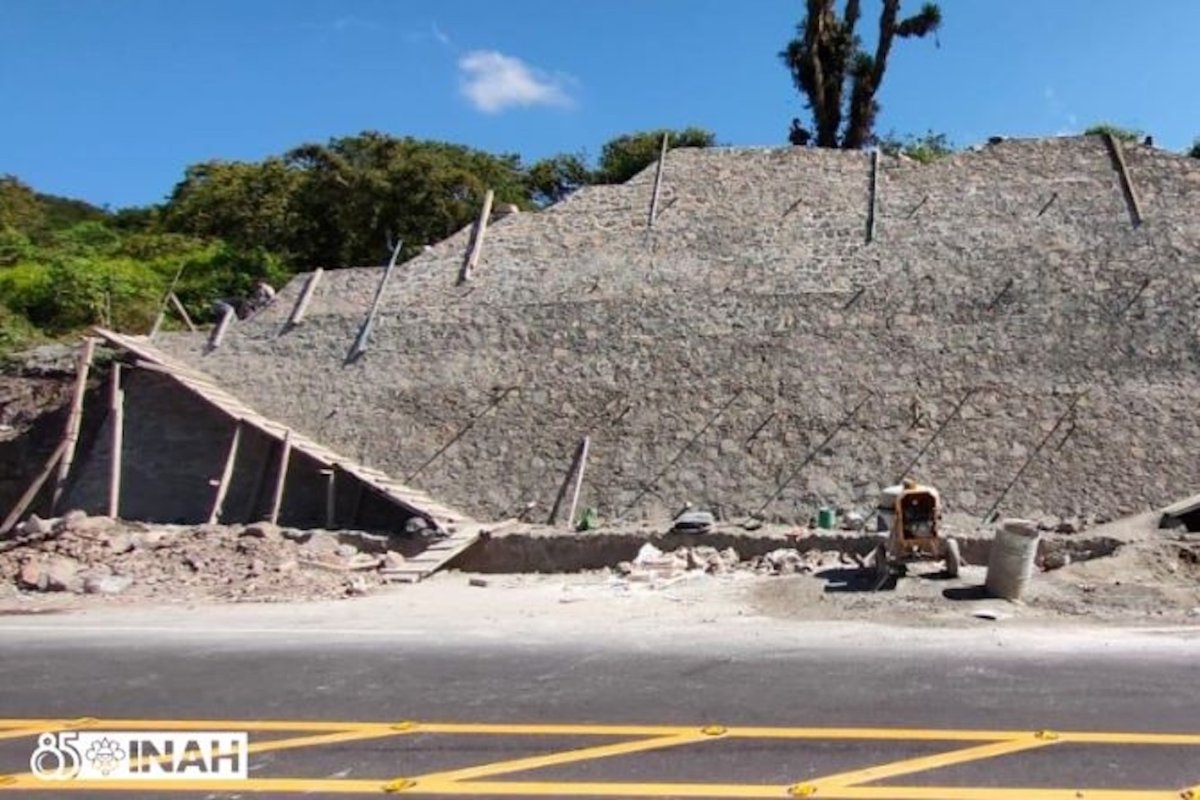
The initial discovery of the pyramidal base in Hidalgo was in June during the construction of a new lane on Mexican Federal Highway 105.
The structure appears to be part of a pre-Hispanic settlement named San Miguel, which has been cataloged and reported to the INAH's Public Register of Archaeological and Historic Monuments and Zones.
The heritage site consists of five sectors and at least 10 archaeological mounds, according to the INAH. It predates European colonization in the region, which began in the early 16th century.
Following the discovery of the structure, the INAH conducted an archaeological rescue project, exhaustively documenting the site with the support of drones. These were used to take images for creating digital photogrammetric models.
During the investigations, researchers also collected numerous samples from coal, earth and charred wood, among other materials, that will be studied in a lab to obtain archaeological data.
After the research project concluded, the structure was reburied for conservation purposes. Before that, it was protected with a geotextile material. A geotextile is a type of material that is sometimes used in archaeological conservation to protect and stabilize archaeological structures and sites.
The recent findings will contribute to the understanding of human occupation in the Sierra Alta region of Hidalgo, specifically in the Barranca de Metztitlán area, where the first settlements are thought to date back at least 14,000 years.
Do you have a tip on a science story that Newsweek should be covering? Do you have a question about archaeology? Let us know via science@newsweek.com.
Originally published by newsweek.com. Syndicated material does not necessarily reflect the views of Grazia British.
More Lifestyle

Millennium Docs Against Gravity Festival Director on How Documentary Film Helps Audiences Find ‘Sense Amid the Chaos’ of Current Events
Poland’s Millennium Docs Against Gravity, the documentary film festival that takes place simultaneously across seven Polish cities, returns for its 23rd edition from May 7 – 17 with a…

Mubi Acquires Na Hong-Jin’s Korean Thriller ‘Hope,’ Starring Michael Fassbender, Alicia Vikander and Hoyeon, For Multiple Territories Ahead of Cannes Premiere
Mubi is once again flexing it financial muscle ahead of Cannes, picking up one of the buzziest films heading to this year’s festival. The arthouse distributor and production company has…

MetFilm Sales Acquires Mongolian Documentary ‘Colors of White Rock’ Ahead of World Premiere at Tribeca (EXCLUSIVE)
London-based MetFilm Sales has acquired Mongolian filmmaker Khoroldorj Choijoovanchig’s debut feature documentary “Colors of White Rock” for worldwide sales representation. The film will…

Brit Detective Drama ‘Bergerac’ Bought for U.S. by PBS Distribution (EXCLUSIVE)
British detective drama “Bergerac” is heading to the U.S. with PBS Distribution following a deal with Banijay Rights. The acquisition comes ahead of next week’s London TV Screenings, with…