
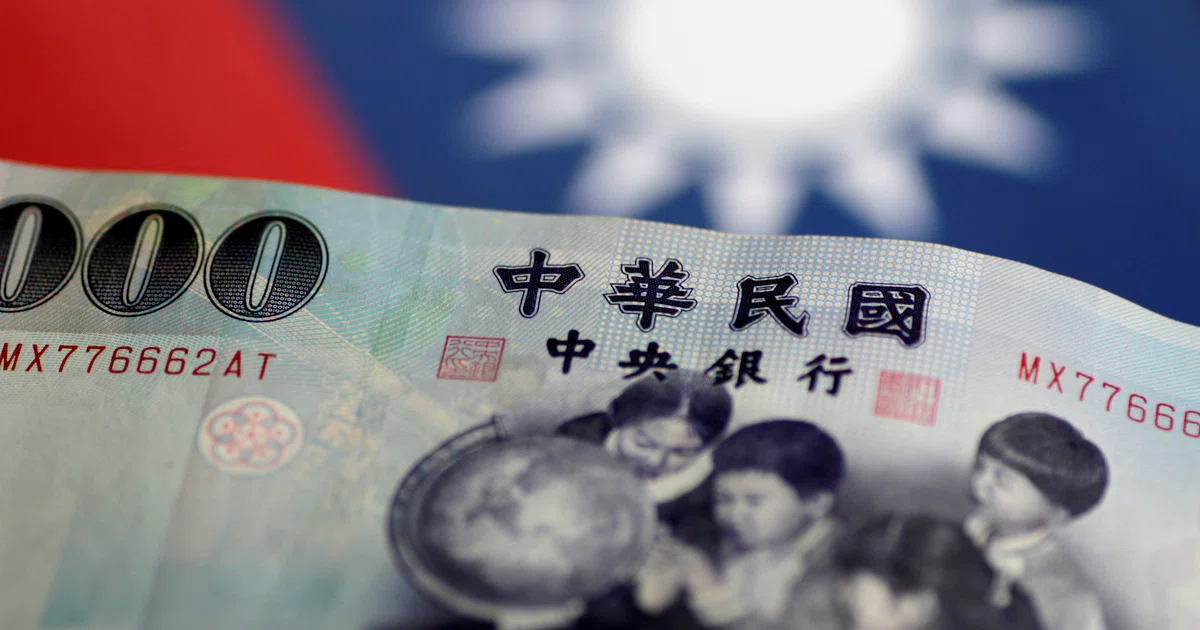
Taiwan’s life insurers see big drop in currency hedging costs
The Taiwan dollar’s recent weakness and the resulting return of carry trades are quickly driving down local life insurers’ hedging costs.
Three-month dollar hedging costs using Taiwan dollar’s offshore forwards, derived from the differential in the US overnight-indexed swaps and Taiwan dollar implied yield, have dropped to just 3 per cent for the Taiwanese insurers, from as high as 14 per cent three months ago, according to Bloomberg calculations. This decline benefits insurers seeking protection against abrupt currency swings and is largely driven by the Taiwan dollar’s underperformance this quarter and its increased use as a funding currency in carry trades.
“The drop in hedging costs is driven by the increased positioning back to longing the greenback against the Taiwan dollar, after the extreme levels seen in June and May,” said Wee Khoon Chong, a strategist at BNY. “The Taiwan dollar’s weakness against the US dollar past the 30 level was a surprise to many, hence driving investors to cover those bets.”
Taiwanese insurance companies have more than 90 per cent of their overseas assets denominated in the greenback. Declines in the US currency may leave them exposed to billions of US dollars in foreign exchange losses, as happened in May, when the local dollar surged the most in a day since 1988. BNP Paribas expects Taiwan’s insurers to increase hedges in the latter part of the fourth quarter due to seasonality.
Carry trades, in which investors borrow in low-interest-rate currencies to invest in assets from higher-interest-rate regimes, have also contributed to the decline in hedging costs.
“Since volatility is decreasing globally, investors are trying to add carry to their portfolios,” said Chandresh Jain, EM Asia rates and FX strategist at BNP Paribas. “They are taking long positions in high-yielding currencies from around the world” and using the Taiwan dollar as a funding currency.
BT in your inbox

Start and end each day with the latest news stories and analyses delivered straight to your inbox.
While the drop in costs presents a chance for the island’s insurers to increase their hedge ratios, market flows and commentary suggest they have yet to take much advantage.
Fubon Life Insurance, for example, said that it will use NDFs as a short-term hedging tool “tactically and flexibly” when it sees room for Taiwan dollar appreciation, while continuing to build a reserve fund to absorb foreign exchange losses.
Strategists still expect the Taiwanese dollar to strengthen against the greenback as the Federal Reserve moves to cut interest rates and Taiwan’s economic fundamentals remain strong.
“Not hedging in a weakening US dollar environment might be detrimental for the insurers’ earnings,” given the positive outlook for local stocks and the local currency that’s supported by Taiwan’s economic strength, BNY’s Chong said. BLOOMBERG
Originally published by businesstimes.com.sg. Syndicated material does not necessarily reflect the views of Grazia British.
More Culture

Don’t Pull Out of Germany
Merz’s stupidity is no excuse for a stupid response. Source link

Step inside the gorgeous, futuristic offices of Vast, the startup designing the next-gen space station
A tall baobab tree greets people inside the Long Beach, California, headquarters of Vast, an aerospace company that is building the space station of the future. It’s planted beneath a…

5 ways high-performing teams stay calm when everything’s on fire
When markets swing, plans break, inboxes explode, and everyone starts saying the situation is “unprecedented” again, most teams do what humans have always done under pressure: they grip…

Confused Trump Openly Admits Plot to Rig Midterms as Polls Turn Brutal
Last week, the Supreme Court gutted protections against racial gerrymandering, and Donald Trump is already urging Republicans to seize on it. Trump unleashed a Truth Social rant on Monday…