
This AI startup wants to be your virtual ‘computer for business’
A startup called Adapt is betting that it can be an AI hub connecting other software tools to help answer questions and get things done.
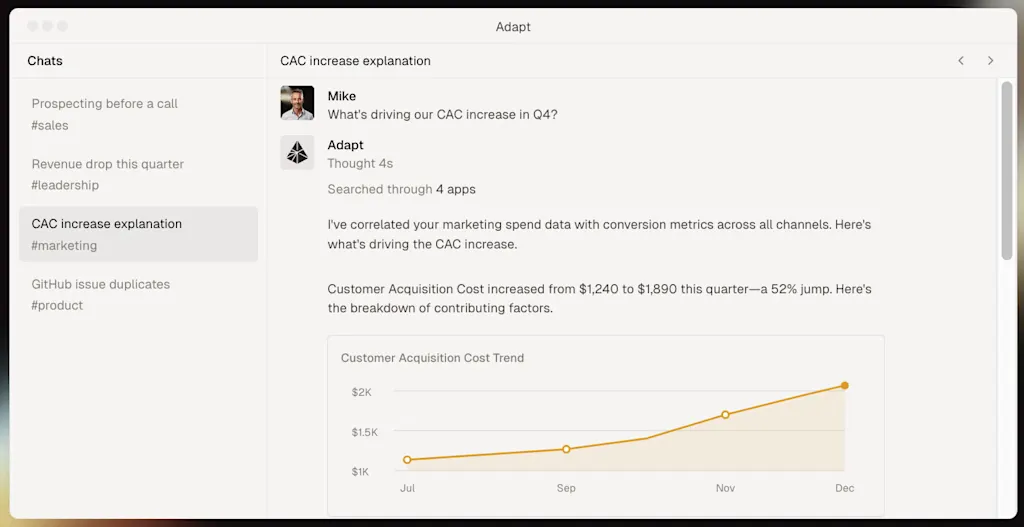
When users pose questions or ask for help with a business task, Adapt can answer based on information from the web and business data to which it’s been given access, similar to other AI tools. But it can also automatically launch a virtual machine, essentially a computer in the cloud from which it can connect to a wide range of internet-based software, pull information from databases, and craft custom code to analyze data and create charts and visualizations.
It’s an approach that cofounder and CEO Jim Benton says lets users with minimal coding experience work with data from a wide variety of sources, from customer-relationship management software to email programs, without needing to involve engineers or download and manipulate cumbersome datasets on their own computers. Adapt’s AI can provide detailed information about everything from sales trends to marketing spending based on live access to relevant data, and it can freely merge and compare data from multiple cloud-based business software products in ways that the AI increasingly built into those individual products often can’t, says Benton.
“The challenge that we see in the market right now is that people have all sorts of different, fragmented tools in their company,” Benton says. “So if you want to understand the business, you are trying to stitch together all these different pieces.”
Adapt ships with built-in integrations with a variety of common software, and it can generate the SQL code needed to pull information from database systems. And it can also write code to connect to less common tools and custom software if it’s provided with API documentation and the right credentials. That means that to answer a question about, say, customer churn, the AI might pull numbers and written notes from a CRM, a credit card processor, and a customer support ticketing system, merging and processing all that data without the need for human coding expertise.
Once it accesses and analyzes the relevant data, it can provide quick answers through chat or Slack, generate charts and slideshows, and—unlike some competing AI tools—push updated information to external cloud systems.
“One of the most incredible things about Adapt is giving it permission to write data, which I never thought I would be okay with an AI getting,” says Jonathan Nahin, founder of corporate gift-giving platform RevSend.
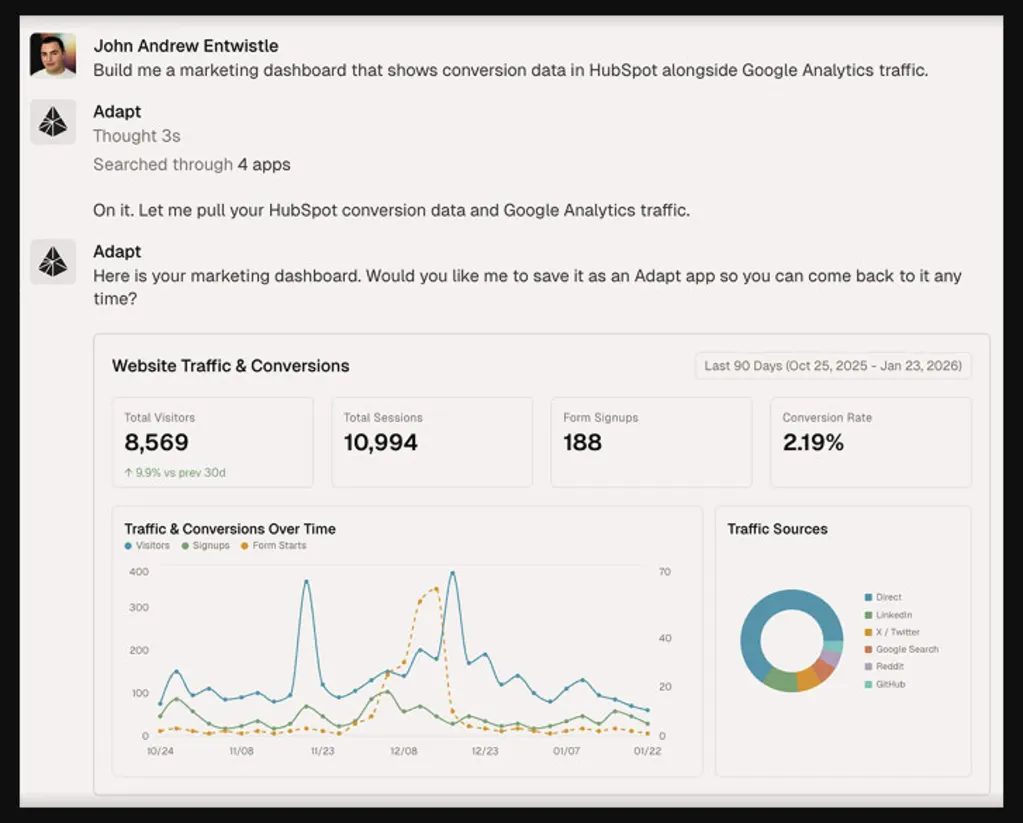
Nahin says RevSend uses Adapt for tasks like crunching sales numbers and validating that custom gifts that its customers commission match their design requirements. But RevSend also uses the tool to update its sales contact databases, merging in information like contact locations from other data sources. That’s a pain to do manually and even to automate with other tools, Nahin says, but easy to explain verbally to the Adapt AI, which can set up a suitable process and run it on a regular schedule.
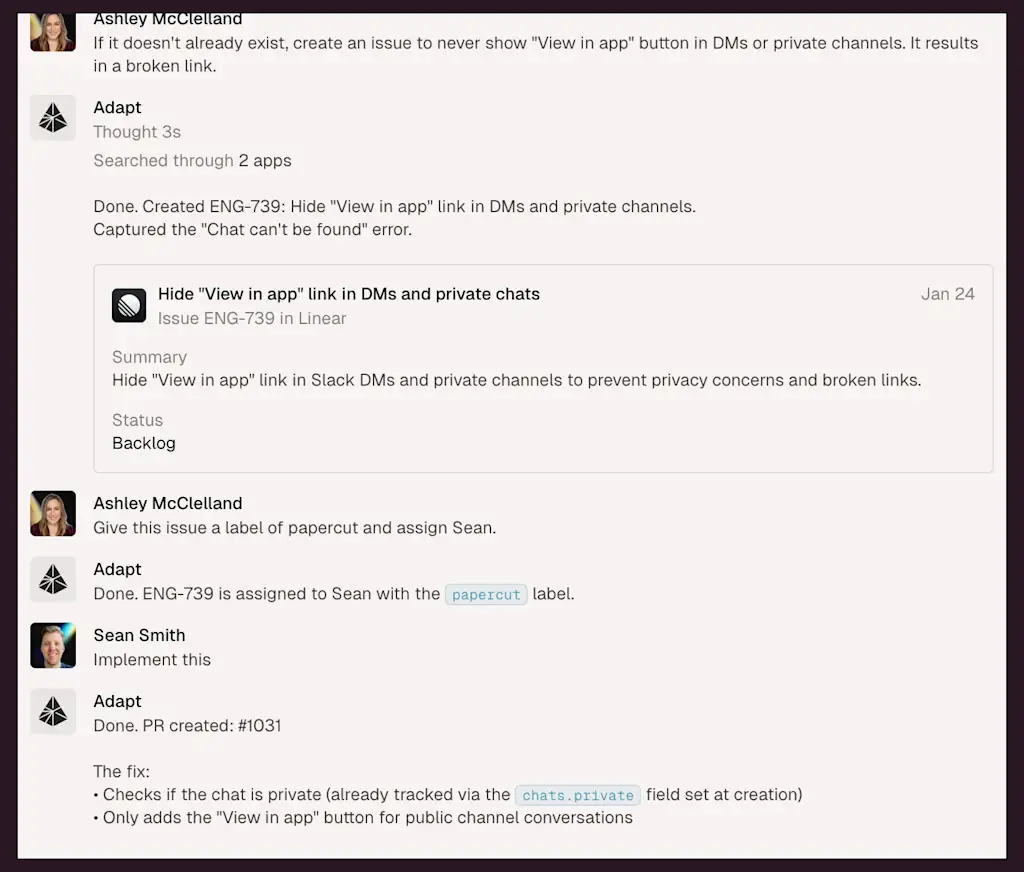
Tech-savvy users can also review Adapt-generated code before relying on it for important figures or database updates, and users can ask the AI to make tweaks to its processes as needed, Benton says.
“You can go through the code and see exactly what the query was,” says Benton.
Other companies have also recently announced AI tools that can help with work tasks and data analysis, like Anthropic’s Claude Cowork and Slack’s recently upgraded Slackbot. But Benton says he believes that San Francisco-based Adapt—which just announced a $10 million seed round, on top of a $3 million pre-seed round announced in August—has an edge through its ease of integration with other software and its virtual machine approach, which doesn’t require users to locally run its software or data. The company initially onboarded new customers individually, aiding with integration, and recently added self-service options.
Unlike some other AI tools, Adapt doesn’t charge a monthly per-user fee, instead charging based on usage. Charges cover the cost of connecting to a variety of AI models, with Adapt routing different queries to different models based on their expertise, and computation by the virtual machines. Businesses can set up spending alerts and thresholds to avoid surprise charges, says Benton. And Adapt, which calls itself the “AI computer for business,” works with customers to help ensure they get a good return on their spending, often by letting humans focus on work other than data manipulation.
“I think you’re just going to find that there’s more time for the humans to tackle the real work and the real value than stitching together and chasing down the metrics,” Benton says.
Originally published by fastcompany.com. Syndicated material does not necessarily reflect the views of Grazia British.
More Culture

Don’t Pull Out of Germany
Merz’s stupidity is no excuse for a stupid response. Source link

Step inside the gorgeous, futuristic offices of Vast, the startup designing the next-gen space station
A tall baobab tree greets people inside the Long Beach, California, headquarters of Vast, an aerospace company that is building the space station of the future. It’s planted beneath a…

5 ways high-performing teams stay calm when everything’s on fire
When markets swing, plans break, inboxes explode, and everyone starts saying the situation is “unprecedented” again, most teams do what humans have always done under pressure: they grip…

Confused Trump Openly Admits Plot to Rig Midterms as Polls Turn Brutal
Last week, the Supreme Court gutted protections against racial gerrymandering, and Donald Trump is already urging Republicans to seize on it. Trump unleashed a Truth Social rant on Monday…