Trump Promised to End Inflation. He’s Bringing It Back Instead.

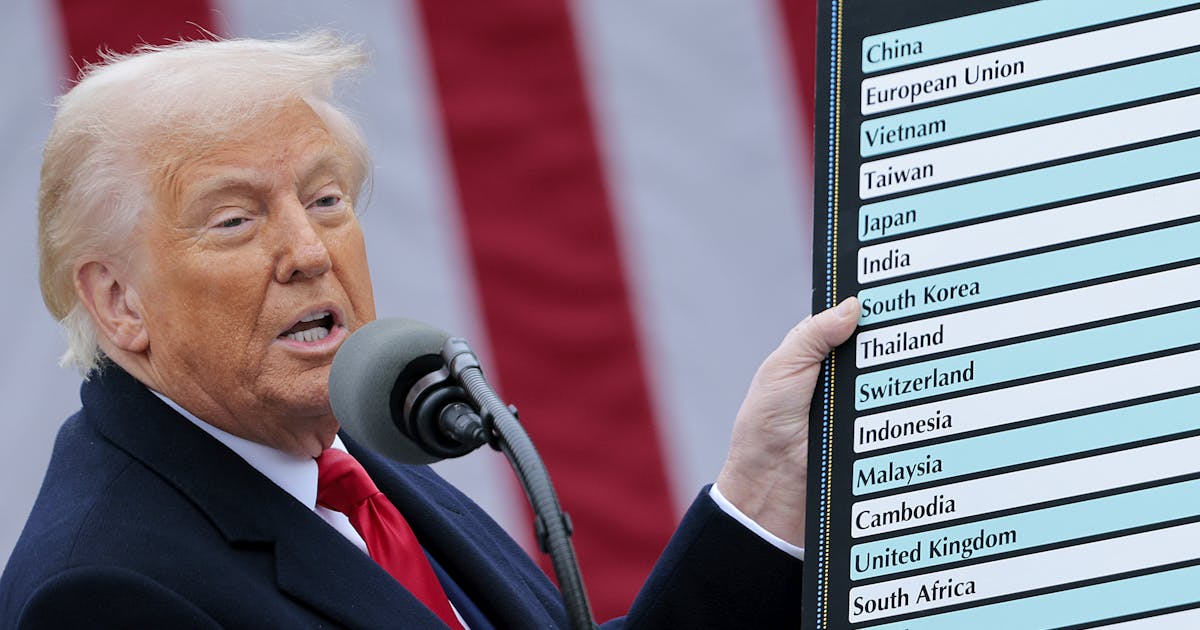
The only uncertainty about how much inflation Trump’s tariff policy will create going forward is that we don’t know what Trump’s tariff policy will be from one day to the next. The stock market has evidently decided not to worry because, as investors see it, Trump is constantly threatening tariffs against individual nations and then chickening out. But Trump is also constantly threatening tariffs against individual nations and not chickening out. You can go crazy trying to keep track of which tariffs are on right now and which are off, but mere threats raise prices, too, as foreign nations put exports on hold while the roulette wheel spins.
Bloomberg has a handy tracker that’s color-coded for whether the given tariff is “imposed,” “announced,” “threatened,” “paused,” or “removed.” Currently in effect are a 10 percent universal tariff on all imported goods; a 25 percent tariff on all imported steel and aluminum; a 10 percent tariff rate on all Chinese goods; and a 10 to 25 percent tariff on all goods from Canada and Mexico, excepting those covered by the United States-Mexico-Canada agreement, which Trump negotiated during his first term. The USMCA carveout exempts most Mexican and Canadian imports; it’s not yet clear whether newly announced 5-10 percent tariffs against those countries set to take effect August 1 will continue to respect Trump’s own trade deal.
The emphasis on China (which is a trade offender) and Canada and Mexico (which are not) supports my view that Trump’s tariff fixation is entirely about exercising unitary power of the purse in a futile (and unconstitutional) attempt to replace the $4.5 trillion in revenue that he just pissed away in the tax bill. These three nations are America’s top trading partners, so, in theory, squeezing them ought to raise the most money. But the problem when you slap tariffs on America’s top trading partners is that you maximize their inflationary effect on American consumers. According to the Yale Budget Lab, Americans are right now paying an effective tariff rate of 18.7 percent, which is the highest since 1933.
Trump’s economic advisers, and especially those who want to replace Jerome Powell at the Fed, refuse to acknowledge this new evidence that Trump’s tariffs are inflationary. “I wouldn’t put too much emphasis on one number,” Treasury Secretary Scott Bessent said on CNBC the night before the CPI was announced. (Bessent claimed he had access to the number but didn’t look.) More boldly, Kevin Hassett, director of the National Economic Council, who also appeared on CNBC the night before the CPI was announced, argued, on the basis of a report by the White House Council of Economic Advisers, that “import prices … are dropping.” His reasoning was dubious:
Originally published by newrepublic.com. Syndicated material does not necessarily reflect the views of Grazia British.
More Culture

Don’t Pull Out of Germany
Merz’s stupidity is no excuse for a stupid response. Source link

Step inside the gorgeous, futuristic offices of Vast, the startup designing the next-gen space station
A tall baobab tree greets people inside the Long Beach, California, headquarters of Vast, an aerospace company that is building the space station of the future. It’s planted beneath a…

5 ways high-performing teams stay calm when everything’s on fire
When markets swing, plans break, inboxes explode, and everyone starts saying the situation is “unprecedented” again, most teams do what humans have always done under pressure: they grip…

Confused Trump Openly Admits Plot to Rig Midterms as Polls Turn Brutal
Last week, the Supreme Court gutted protections against racial gerrymandering, and Donald Trump is already urging Republicans to seize on it. Trump unleashed a Truth Social rant on Monday…