
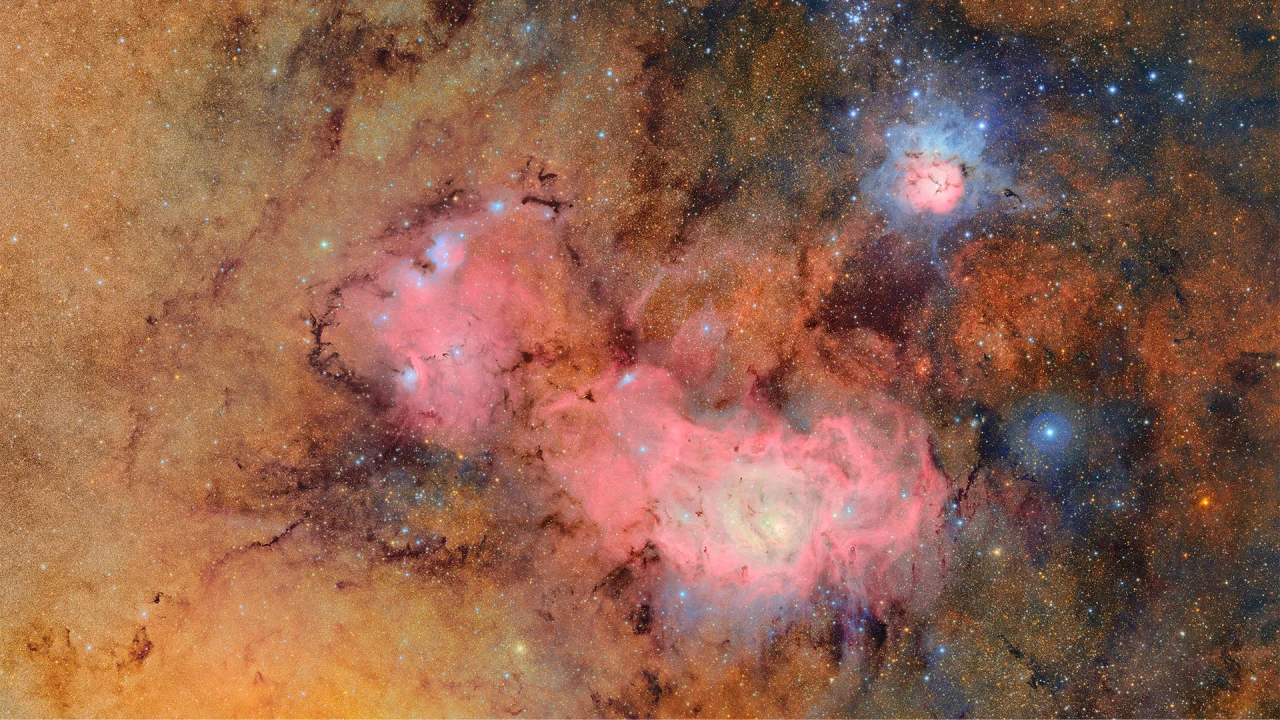
Vera Rubin Observatory reveals jaw-dropping first images from world’s largest telescope
This morning, the world’s largest telescope revealed its first-ever images of space—and they’re pretty jaw-dropping.
The images come courtesy of the NSF–DOE Vera C. Rubin Observatory, a scientific facility funded by the U.S. National Science Foundation and the U.S. Department of Energy’s Office of Science. Located at the summit of Cerro Pachón in Chile, the facility is the product of more than 20 years of work. Its space camera—embedded in the hulking Large Synoptic Survey Telescope (LSST)—is about the size of a small car and includes a sensor array of three billion pixels, the most sensors ever used in a telescope camera.
According to a press release from the Rubin Observatory, it’s expected to generate an “ultrawide, ultra-high-definition time-lapse record of the Universe.”
“It will bring the sky to life with a treasure trove of billions of scientific discoveries,” the release reads. “The images will reveal asteroids and comets, pulsating stars, supernova explosions, far-off galaxies and perhaps cosmic phenomena that no one has seen before.”
“The most efficient Solar System discovery machine ever built”
In just its first 10-hour test observation, unveiled today, the LSST managed to capture images which include millions of galaxies and Milky Way stars, as well as more than 2,000 never-before-seen asteroids within our Solar System. Taken together, the photos illustrate a technicolor view of space at a mind-boggling scale—but the 10 million galaxies photographed by the LSST represent only 0.05% of the roughly 20 billion galaxies that the camera is expected to record within the next decade.
The primary goal of the LSST is to complete a 10-year survey of the Southern hemisphere sky, capturing hundreds of images and around 20 terabytes of data per night throughout that period. Per the Rubin Observatory, this massive influx of data will make the LSST “the most efficient and effective Solar System discovery machine ever built.” All of the captured data will be made available online, allowing astronomers across the globe to access countless new findings without physical access to the telescope.
The LSST is designed to advance four main areas of study: Understanding the nature of dark matter and dark energy; creating an inventory of the Solar System; mapping the Milky Way; and exploring the transient optical sky, i.e. studying objects that move or change in brightness. Experts predict that, given its capacity to identify millions of unseen asteroids, comets, and interstellar objects, the camera could even help protect the planet by spotting objects on a trajectory toward the Earth or Moon.
“NSF–DOE Rubin Observatory will capture more information about our Universe than all optical telescopes throughout history combined,” Brian Stone, chief of staff at the National Science Foundation, said in a press release. “Through this remarkable scientific facility, we will explore many cosmic mysteries, including the dark matter and dark energy that permeate the Universe.”
Originally published by fastcompany.com. Syndicated material does not necessarily reflect the views of Grazia British.
More Culture

Don’t Pull Out of Germany
Merz’s stupidity is no excuse for a stupid response. Source link

Step inside the gorgeous, futuristic offices of Vast, the startup designing the next-gen space station
A tall baobab tree greets people inside the Long Beach, California, headquarters of Vast, an aerospace company that is building the space station of the future. It’s planted beneath a…
5 ways high-performing teams stay calm when everything’s on fire
When markets swing, plans break, inboxes explode, and everyone starts saying the situation is “unprecedented” again, most teams do what humans have always done under pressure: they grip…

Confused Trump Openly Admits Plot to Rig Midterms as Polls Turn Brutal
Last week, the Supreme Court gutted protections against racial gerrymandering, and Donald Trump is already urging Republicans to seize on it. Trump unleashed a Truth Social rant on Monday…