
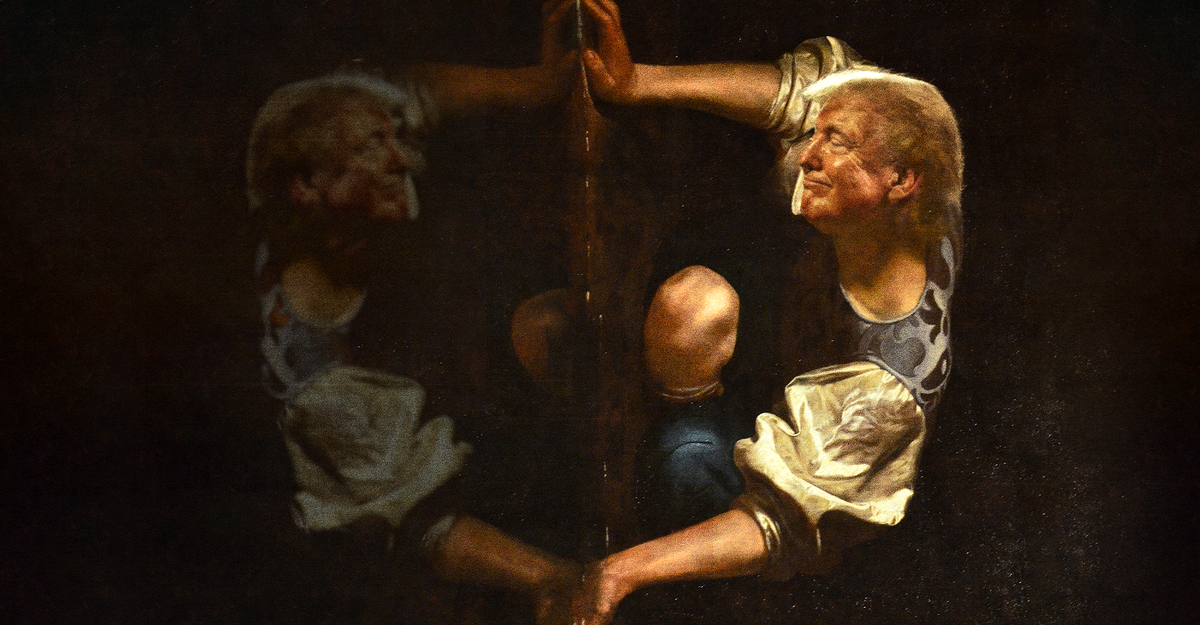
What Trump’s Bizarre Posts Are Teaching Us About AI
This article was featured in the One Story to Read Today newsletter. Sign up for it here.
Here is a selective list of the dozens of images the president has recently disseminated on Truth Social: Donald Trump on a horse next to George Washington on a horse, in the body of Hulk Hogan, beating Hogan in arm wrestling, standing between General George Patton and General Douglas MacArthur in a World War II uniform, hovering menacingly with a hockey stick over the Canadian prime minister, commanding the deck of an aircraft carrier, nuking parts of Earth from space, gleefully dancing to “YMCA” as he replaces a sign for Lake Ontario with one for Lake America. Maybe most surreal (though, admittedly, kind of funny), he posted a video of a squad of “Donald Ducks” with his signature hair, armed with machine guns, waddling in formation to protect said lake.
Trump has never been shy about his proclivity for self-aggrandizement (daydreaming about having his face chiseled onto Mount Rushmore or printed on a $250 bill). But his recent spate of social-media posts—almost all products of AI—has him living in an expanded fantasyland. His supporters are likely to just giggle; more fun and trolling—so what? His critics might roll their eyes at the extravagant immaturity but almost can’t be bothered anymore (unless they’re Iceland). After a decade of Trump shenanigans, getting worked up either way is hard. Also, these images might come across as just a little sad—the projections of a man who is losing power and virility but desperately needs to see himself as powerful and virile.
The absurd cartoons are worth pondering, though, and not for the sake of getting to know Trump better (I believe that onion has been thoroughly peeled). Because what AI can do to exaggerate and aggrandize Trump, it can do to everyone. For the president, this may be just one more level up on his escalator of self-regard, but for those without Napoleonic degrees of narcissism, the mental terrain opened up by these quick-prompt chimeras is new.
When the psychoanalyst Jacques Lacan wanted to understand how the ego takes shape, he thought of mirrors. Sometime from six to 18 months of age, he theorized, a baby begins to recognize their reflection, and experiences what Lacan—abstruse French structuralist that he was—described as the “jubilant assumption of his specular image.” In plainer words, the baby realizes, That’s me! This is significant because the child at this point is otherwise a fragmented mess, experiencing the world through disconnected sensation. Lacan thought the mirror provides an idealized perception of wholeness when, really, inside it’s all a scramble, and through this illusion of coherence, a proper ego—a sense of self—begins to bud.
Read: Trump’s giant face is everywhere
Lacan didn’t believe that we ever really outgrow this reliance on our reflection, whether seen above a bathroom sink or in the ways other people look at us. But the mirror he had in mind could show you only the person who stands in front of it—the image is always tethered to physical reality. The AI mirror is something else. It asks what we’d like to see and produces it.
In the past, only kings and emperors could indulge their most exalted, exaggerated picture of themselves. They could commission heroic, larger-than-life representations—though even these were limited by available materials and plausible realism. AI image-making has now democratized this kind of statue-building. I know because I just asked ChatGPT to create an image of me astride a bronze horse in the center of a city, and I’ve never looked more commanding. But AI can do so much more: The ideal self has escaped the confines of the mirror and even the gilded sculpture; it can now inflate to unimaginable dimensions.
In this new world, our insecurities are not obstacles; they are starting points. Take my modest height. I can conjure up what I would look like in Victor Wembanyama’s stretched-taffy body—though I’d settle for something one foot shorter. I’m fully aware that this is just an image, and a bizarre one, but it engraves this taller me—a version who walks into a party and looks down, not up, at everyone—into my brain. It creates a gulf between reality and such a picture. This fantasy made manifest can either delude or taunt me. It exists, and I can’t forget it. Conversely, I should say, it also reveals what I’m most self-conscious about—exactly as AI does for Trump. The puffed up, dominating, victorious man with the six-pack is what the AI mirror shows the president, because that is what he prompts it to show him. (In most cases, of course, he is reposting images prompted by supporters, who are thereby exposing their own displaced fantasies.)
To give Trump a little credit, he seems vaguely aware of the idea that AI is, like the Mirror of Erised in Harry Potter, showing us what we most want. One of his posts has Barack Obama looking into a mirror and asking: Mirror mirror on the wall who’s the greatest president of them all. No surprise, it’s Trump, who is staring back at him.
Read: Let Trump keep building monuments to himself
What I see in the AI mirror is greater than I could ever be—and infinitely editable. Instead of feeding a desire for coherence, as Lacan imagined, it creates a bottomless hunger for the unachievable. I can keep tweaking it with more prompts: “Give me thicker hair. Make my jaw more chiseled.” Start down this road, I’m afraid, and you’ll encounter unhappy young men using hammers to shape their actual faces so that they can come closer to the digital simulacra.
Not all people are narcissists, and certainly not all are like Trump. But we are all susceptible. Who doesn’t dream occasionally of evading reality or the truth of the body you are stuck living in? On the scale of human history, it has been only about a second since we got photography (and the inevitable selfie) to augment what for so long only a pond’s surface or a piece of glass could show us: our own face. What will come from finding, instead, Supermen, kings, popes, and Jedi staring back at us?
Without AI, Trump might be forced to look around him, perhaps at the portraits of other presidents in the White House—just like Richard Nixon did. In their book The Final Days, Bob Woodward and Carl Bernstein recounted what became a famous story: As Nixon’s presidency was crashing down around him, he began talking at night to these dead former presidents. (One of his sons-in-law denied this claim.) Oliver Stone dramatized the moment in his 1995 film, Nixon: The defeated, haggard president focuses on a painting of John F. Kennedy and says, with startling self-awareness, “When they look at you, they see what they want to be. When they look at me, they see what they are.”
Fiction, I know. But this is the kind of reckoning that can happen when you have no choice but to see what is in front of you. Trump is also very aware of the presidents who came before him. In another recent post, he ranks them all in a tiered chart from Great (Lincoln, FDR, Jefferson, and so on) to Failures (Biden, Obama, Carter, and so on). And atop the entire graphic in a box roughly four times the size of all the others, Trump’s severe, unsmiling face looks out under a label that reads back to him: The Greatest.
Originally published by theatlantic.com. Syndicated material does not necessarily reflect the views of Grazia British.
More Culture

Baby 'cot cams' plan after inquiry finds Lucy Letby crimes could have been prevented
Plans will be "urgently" developed for live-streaming cameras after an inquiry report into Lucy Letby's crimes.

US borrowing costs hit highest level since 2007
The effective interest rate on US government bonds over 10 years, known as the 10-year Treasury yield, has risen as high as 5.04% but has eased back since.
British bosses to be forced to meet with employees who request flexible working
Employers will have to hold face-to-face meetings with staff who ask about shift changes under government reforms
Ed Sheeran breaks silence on Macklemore tour backlash: ‘I am not complicit’
‘It’s important that I set out some facts,’ the singer said in a statement shared Tuesday