
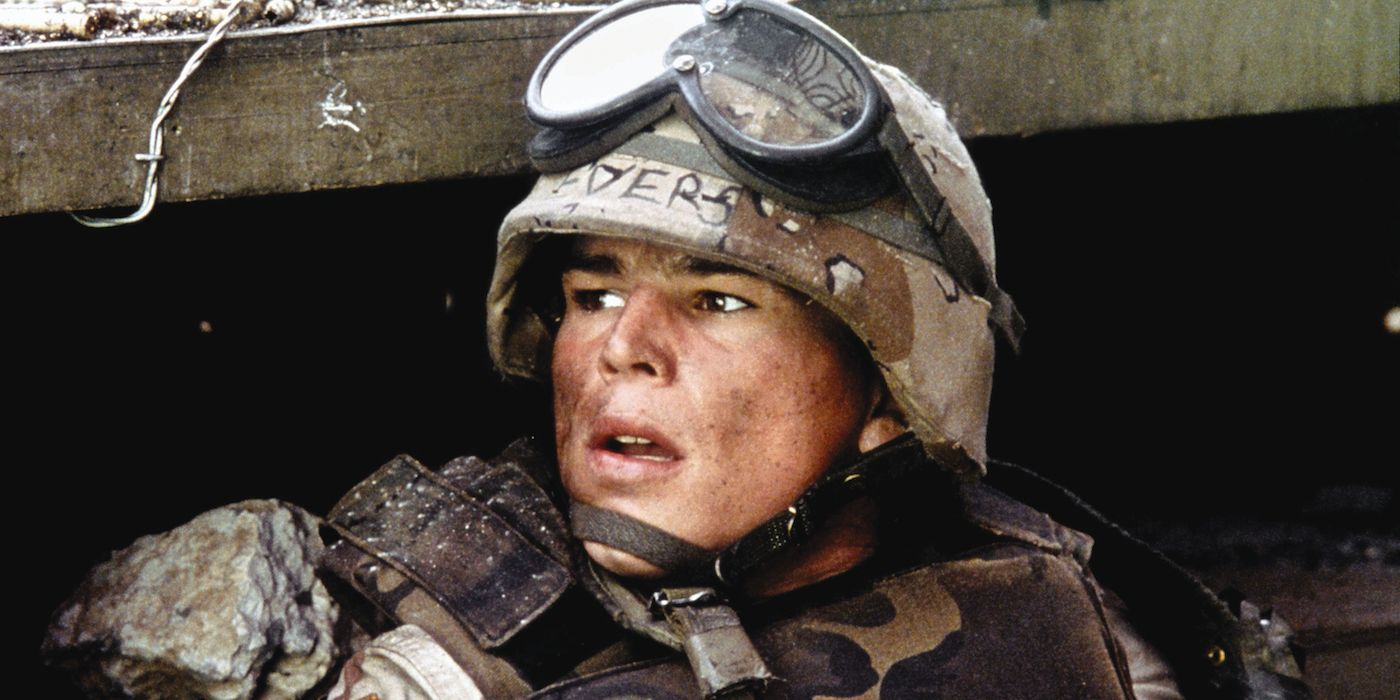
24 Years Ago, Tom Hardy Made His Film Debut in This Ridley Scott War Movie
It’s always a trip to rewind through an actor’s early credits – those blink-and-you-miss-it roles, the baby-faced cameos that tease a glimmer of what’s to come. But it’s especially fascinating when the actor in question is Tom Hardy. Today, he’s an established cinematic chameleon; an accent-chewing contortionist who can make mumblings behind a mask feel Shakespearean and a Sony-branded symbiote sludge endearing. But back in the early aughts, he was just another wide-eyed rookie crammed into Ridley Scott’s gunmetal-tinted, award-winning war epic, Black Hawk Down.
If seeing Hardy’s name pop up on the film’s IMDb credits page felt surprising, that’s probably because Scott’s high-caliber combat drama doubled as a roll call for a generation of actors who would come to define very different corners of Hollywood. The film was stuffed with on-the-brink talent and veteran stars: Josh Hartnett, Orlando Bloom, Ewan McGregor, Eric Bana, Hugh Dancy, Nikolaj Coster-Waldau, Sam Shepard, Jason Isaacs… the list could (and does) go on. Hardy’s SPC Lance Twombly was the kind of relatively minor infantryman who could almost be missed amid the chaos of helicopters, gunfire, and half a dozen future A-listers sardined into the frame. But, as is his style, Hardy managed to make an impression with his blip on the radar bit part, teasing the physicality, charisma, and, weirdly enough, humor that’s come to define his action-filled filmography.
Tom Hardy’s First Film Role in 'Black Hawk Down' Was Easy to Miss but Hard to Forget
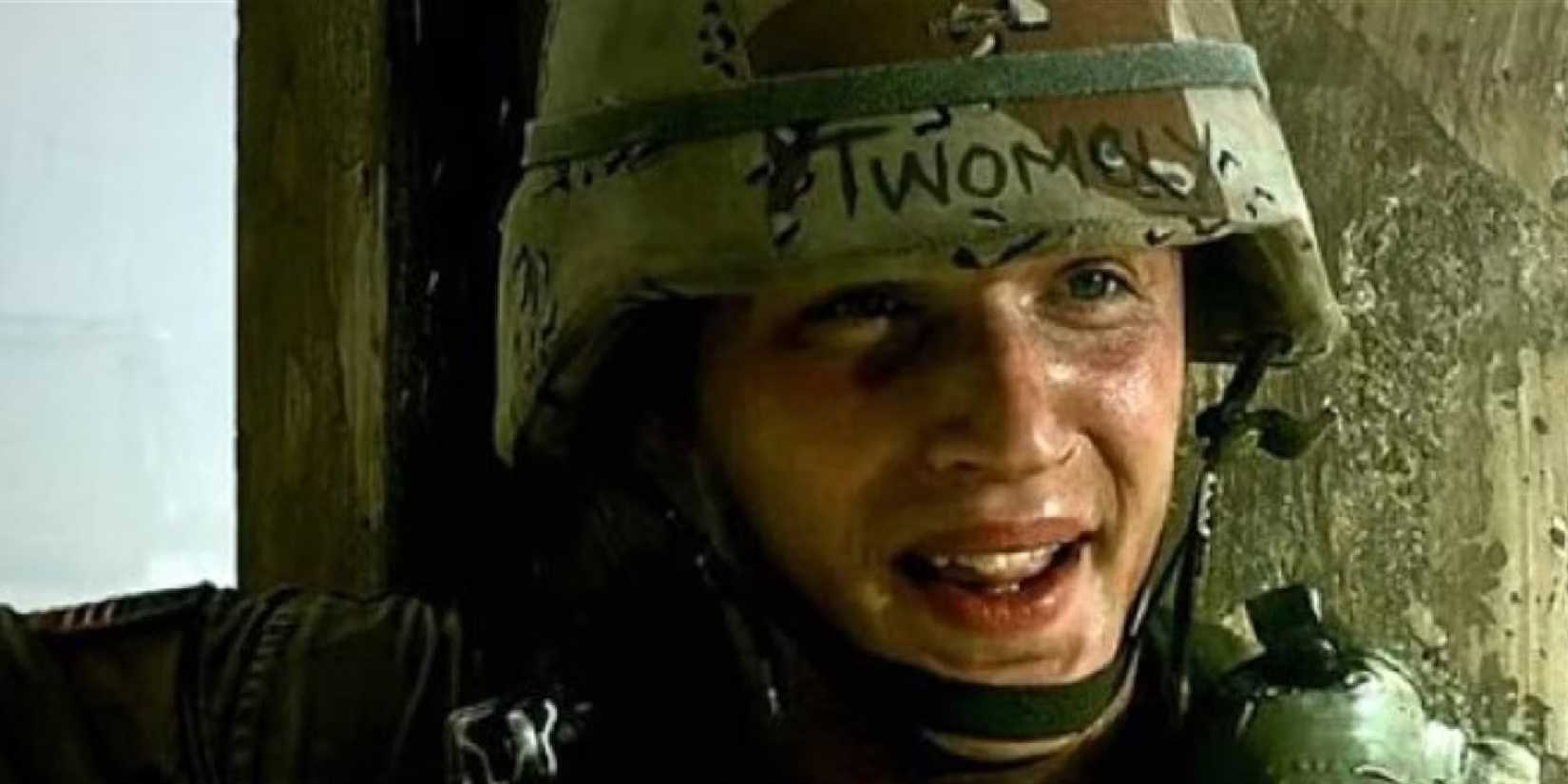
Hardy was just 24 years old when he made his feature film debut in Scott’s grim and gritty war ballet. His Army Ranger Specialist Lance Twombly was a stand-in for a real-life hero, with much of the film’s action pulled from journalist Mark Bowden’s account of the Battle of Mogadishu, which happened in Somalia during the early 90s. With a close-cropped shave and his signature snaggletooth, Hardy shouldered the pressure of playing a still-living soldier with apparent ease. (He shot the film on the heels of a Band of Brothers' stint that required similar commitment and physicality, but offered considerably less screen time.) In Scott’s film, Twombly is separated from his unit after a find and capture mission goes horribly wrong, which meant Hardy shared most of his scenes with Ewen Bremner’s Shawn Nelson, another gunner deafened during a chaotic gunfight whose safety Twombly ultimately feels responsible for. As the pair stumble through the war-torn streets, isolated from the main action and questioning their every judgment call, the audience is treated to an unfiltered look at the disorientation of modern warfare.
But Hardy’s Twombly isn’t the stereotypical war movie hero, charging into the frame with a rallying speech and an explosive battle plan. He’s the guy who gets stuck in the margins, panics a little, makes a bad situation worse, and then somehow holds it together. His and Nelson’s two-man odyssey of confusion, improvised hand signals, and barely-restrained desperation is one of the more interesting elements of Scott’s fairly formulaic film. It’s the quiet unraveling of two soldiers clearly out of their depth, and yet, there’s a strange, accidental comedy in it, born more from the recognition of their shared bad luck and bureaucratic bungling than anything else. One of them can’t hear; the other can’t stop talking. It’d make for a great stand-up routine if bullets weren’t whizzing by every five seconds and death didn’t loom around the next corner of a crumbled building.
Beneath the awkward humor, though, is something darker. Twombly's storyline is all about disconnection, not just from his squad, but from clarity, command, and even reality. While the rest of the film is locked into military precision and high-stakes strategy, Twombly’s experience is messier. He’s not fearless; he’s flailing. And Hardy leans into that: the nervous energy, the physical discomfort, the dawning realization that survival might depend more on serendipity than skill. It’s not the most screen time in the ensemble, but it is one of the most emotionally honest threads in the film. And what makes it memorable, especially in hindsight, is how much of future Hardy is already peeking through this sea of camo.
He’s vulnerable in a way most upstart actors tackling their first war story just aren’t. He’s not trying to be the coolest guy on the battlefield; he’s trying to stay alive, and that makes him stand out among the more generic GI Joe types. Frustration, disillusionment, hopelessness, despair, and survivor’s guilt – he translates it all in just a handful of lines and less than a dozen scenes. It might not be his flashiest cinematic entry, but it is one of his most revealing; a low-stakes part played with surprising depth that feels more like a soft-launch than a supporting role.
How 'Black Hawk Down' Turned Soldiers Into Stars — Hardy Included
The film itself occupies a strange, conflicted place in the war movie canon – Oscar-nominated, endlessly re-aired on FX, and equal parts critique and celebration. On one hand, Scott crafts a frenetic, visceral spectacle that captures the lawlessness and cost of modern combat by subtly indicting the machinery behind it: indecisive command, sloppy planning, and inadequate support from higher-ups all lead to avoidable bloodshed. The film doesn’t defend the military-industrial complex; if anything, it shows how poorly the soldiers are served by the system. And yet, it also revels in its boots-on-the-ground heroics, elevating the slaughter, sacrifice, and unshakable brotherhood of the men who do the bulk of the fighting. It's a movie that condemns the business of war while glamorizing the warriors. And along the way, it became an unlikely Hollywood launchpad: a pipeline for white men on the cusp of six-pack-fueled stardom.
That’s another truth that makes Hardy’s ascension so interesting. Hartnett, McGregor, Dancy — they all received the same amount of screen time. Some went on to heartthrob status, others to criminally good TV work. Many even took the blockbuster franchise route – Hardy included. But while Bloom, McGregor, Ioan Gruffud, and the like played it straight, donning spandex and prosthetics and Jedi robes to cash in on their hero appeal, Hardy went the opposite way: mutating, masking, and mumbling through a career defined by transformation rather than stardom. He embraced an element of otherness, leaned into oddity, and made his name by disappearing into the kind of roles his wartime peers might avoid.
And that instinct was there from the beginning. Even buried in Scott’s beige ensemble, he didn’t need to push for attention; he just felt different. Rewatching it now, Black Hawk Down definitely loses a bit of its sheen. It’s loud, patriotic, and kind of messy when you look at it through today’s lens. But still, Hardy’s performance sticks with you. He’s not the biggest or boldest character, but there’s something real about him. It’s like an early glimpse of the actor Hardy would become. This is a guy who doesn’t just play the role, he makes it feel lived-in. This is an action star who can mix violence with vulnerability to give us something unexpected in our heroes (and anti-heroes). Who knew we'd find him here, of all places?
Black Hawk Down is available to stream on Netflix in the U.S.
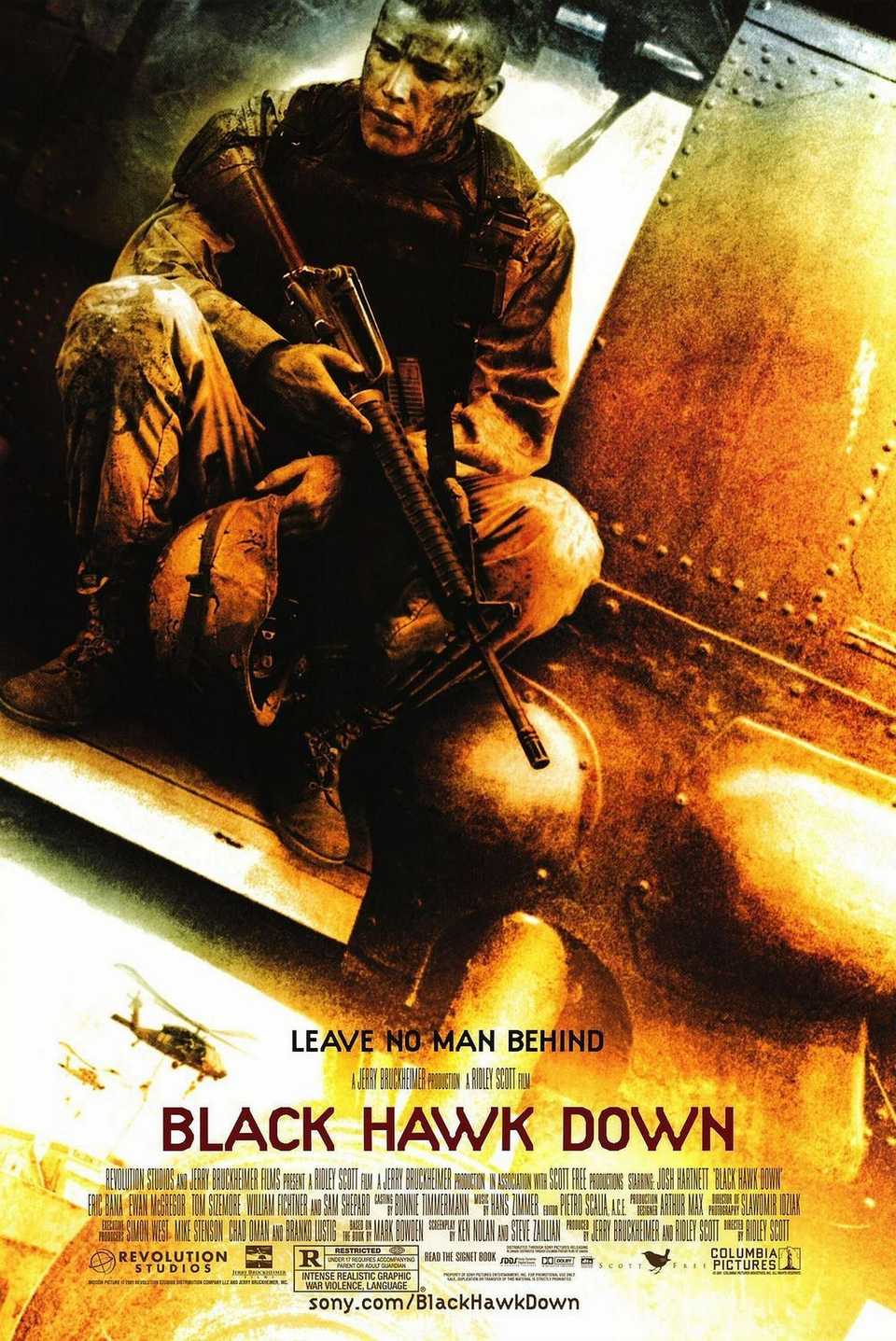
Release Date
January 18, 2002
Runtime
144 minutes
Writers
Ken Nolan
Originally published by collider.com. Syndicated material does not necessarily reflect the views of Grazia British.
More Lifestyle

Millennium Docs Against Gravity Festival Director on How Documentary Film Helps Audiences Find ‘Sense Amid the Chaos’ of Current Events
Poland’s Millennium Docs Against Gravity, the documentary film festival that takes place simultaneously across seven Polish cities, returns for its 23rd edition from May 7 – 17 with a…

Mubi Acquires Na Hong-Jin’s Korean Thriller ‘Hope,’ Starring Michael Fassbender, Alicia Vikander and Hoyeon, For Multiple Territories Ahead of Cannes Premiere
Mubi is once again flexing it financial muscle ahead of Cannes, picking up one of the buzziest films heading to this year’s festival. The arthouse distributor and production company has…

MetFilm Sales Acquires Mongolian Documentary ‘Colors of White Rock’ Ahead of World Premiere at Tribeca (EXCLUSIVE)
London-based MetFilm Sales has acquired Mongolian filmmaker Khoroldorj Choijoovanchig’s debut feature documentary “Colors of White Rock” for worldwide sales representation. The film will…

Brit Detective Drama ‘Bergerac’ Bought for U.S. by PBS Distribution (EXCLUSIVE)
British detective drama “Bergerac” is heading to the U.S. with PBS Distribution following a deal with Banijay Rights. The acquisition comes ahead of next week’s London TV Screenings, with…